Mountains, dunes and nine nights on one loop
Out of Muscat, up onto the Saiq plateau, along the rim of the deepest canyon in Arabia, down into the Sharqiya dunes, then back along the coast through the turtle beach at Ras al Jinz and the wadis above Sur.
At a glance
As at September 2026 the US State Department has Oman at Level 3, Reconsider Travel, updated on 30 August 2026. The reason given is the regional conflict that began on 28 February 2026 and the drone and missile risk that came with it, together with a terrorism risk to tourist sites, transport hubs and markets. A separate Level 4, Do Not Travel, applies to the Yemen border area, which is roughly a thousand kilometres from anything on this route.
That is the advisory as written. It is not our job to argue with it or to tell you what risk to accept. What we can tell you is what we do about it: every Oman departure is quoted on refundable hotel rates wherever refundable rates exist, the deposit is transferable to another date or another country until 45 days out, and we will not run a journey we would not send our own families on. If we stand the departure down, you get the money back rather than a credit note. Read the advisory yourself before you decide, and read our note on advisories and what they mean alongside it.
- Duration
- 10 days, 9 nights
- Party
- Private, 2 to 8
- Starts
- Muscat
- Ends
- Muscat
- Difficulty
- Easy to moderate
- From
- USD 3,900
Oman is a loop, not a line, and that is the single most useful thing to know about planning it. Everything worth ten days sits inside a circle drawn round Muscat: the mountains are two hours inland, the dunes three hours beyond them, and the coast brings you home. Nobody needs an internal flight and nobody backtracks, which is why ten days here buys more ground than ten days almost anywhere else in Asia.
The order matters. Going up before going out means you meet the Hajar mountains while you are still fresh and the desert when you have stopped expecting shade. Reversed, the dunes become the thing you endure between two drives.
This is a country that rewards a traveller who likes rock. Oman has no Petra and no Angkor; it has geology, forts, irrigation channels that have run for centuries, and a coastline where turtles come ashore at night. If you need a single famous object at the end of the drive, the nine-day Jordan journey or the sixteen-day Jordan and Oman voyage will suit you better, and we would rather say so now than at the end of day four.
Day by day
A standard saloon car handles the whole Muscat – Nizwa – Wahiba – Sur circuit without difficulty. Four-wheel drive is genuinely required in exactly two places: the final ascent onto the Jebel Shams summit plateau, where the gradient and the gravel strand ordinary cars, and the transfer from the road into the dunes at your desert camp. We run this journey in a 4WD throughout rather than swapping vehicles mid-route, so those two days need no arranging on your side.
Arrive Muscat
Met at Muscat International and driven along the coast into the old city, about half an hour outside the evening rush. Nothing is scheduled and nothing should be; most flights from Europe land in the early hours.
If you land in the morning instead, the walk that makes sense is the Mutrah corniche from the fish market to the souq gate and back, done slowly, at the end of the afternoon when the heat comes off the water.
Muscat, on foot and by sea wall
The Sultan Qaboos Grand Mosque opens to non-Muslim visitors for a set window in the morning and closes to them before the midday prayer. Arms and legs covered, a headscarf for women, shoes off at the door. We confirm the current window the week you travel rather than printing an hour that may have moved.
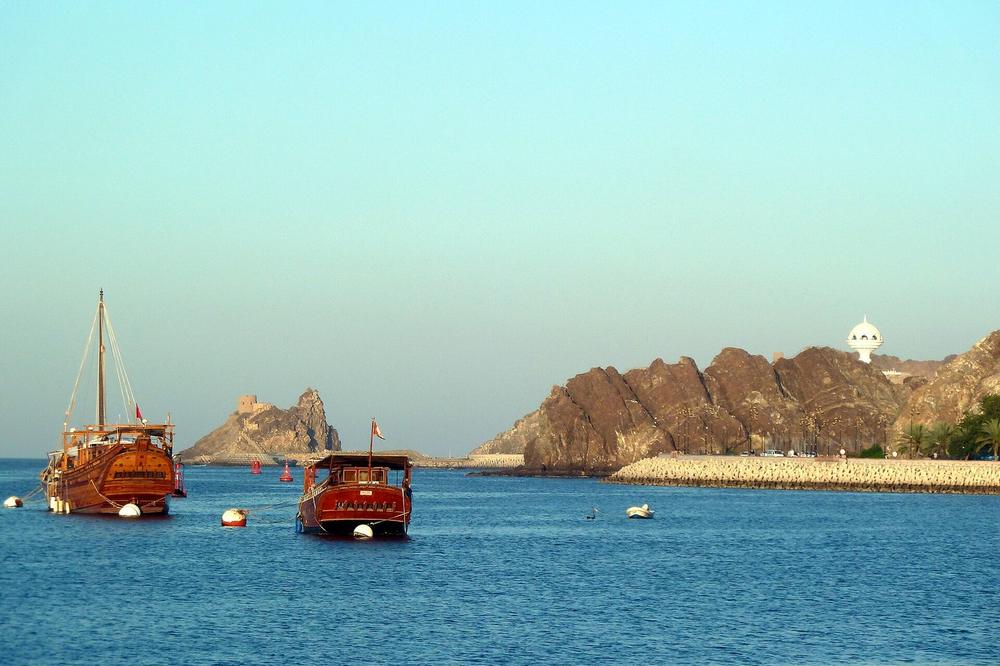
After it: Bait Al Zubair, which is the one museum in the country that explains what you will be looking at for the next eight days, and the Mutrah souq, which is a working market with a tourist aisle rather than the other way round. Old Muscat in the late afternoon — the palace between its two Portuguese forts, both of them still military and neither open.
Muscat to Nizwa and up onto the Jebel Akhdar
Leave at 08:00 for Nizwa, about 160 km and an hour and a half on a good road through the gap in the Hajar range. Nizwa was the interior capital when the coast and the interior were separately governed, and the round tower of its fort was built to survive that argument. The souq beside it still sells dates, silver and copper. If your dates catch a Friday morning we build the week around the livestock auction, which runs then and at no other time.
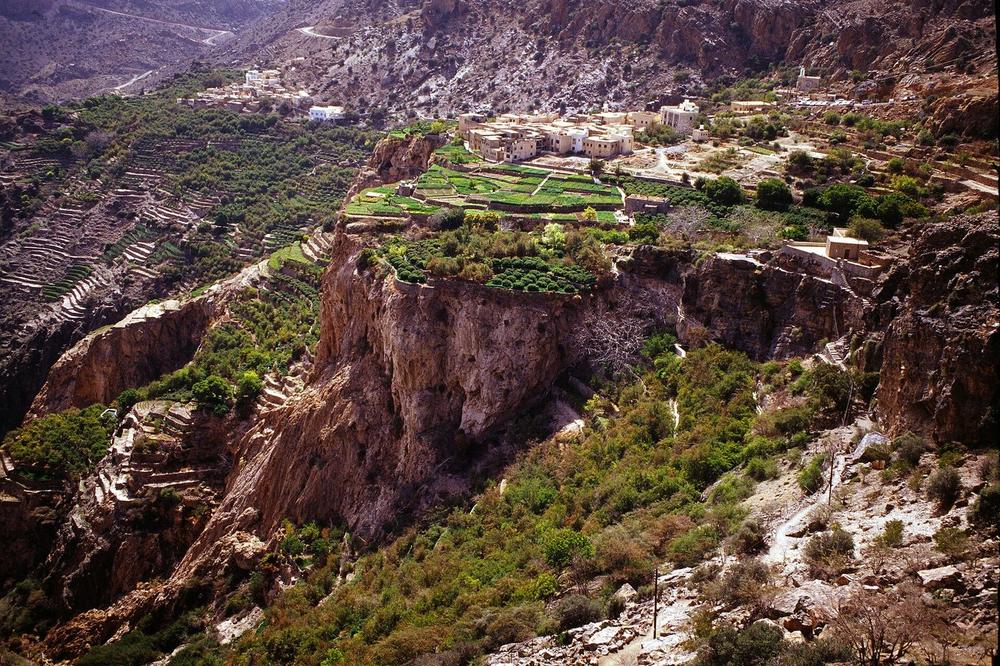
The road up to the Saiq plateau climbs steeply out of the Wadi Muaydin and gains most of its height in twenty minutes of switchbacks. At the top the air changes: the Jebel Akhdar sits between about 18 and 26°C when Muscat and the interior are far hotter, which is why Omanis have farmed it in terraces for as long as anyone can date the irrigation channels.
The terrace villages
The walk between Al Aqr, Ash Sharayjah and Al Ayn is the reason to sleep up here rather than drive up for lunch. A stone path follows the falaj, the open irrigation channel that feeds the terraces in a rotation the villages have policed for generations, and drops from one hamlet into the next. The terraces are planted with damask roses; the harvest and the distilling are a spring event, so outside it you see the terraces and not the flowers, and anyone who tells you otherwise is selling a photograph.
The afternoon goes to Wadi Bani Habib, a village of collapsing mud-brick houses on the far side of a walnut grove, abandoned within living memory. The steps down and back up are the only real effort of the day.
Jebel Akhdar to Jebel Shams by way of Misfat al Abriyeen
Down off the plateau, west through Al Hamra, and up to Misfat al Abriyeen, a mud-brick village built onto a rock spur above its own date gardens. The falaj runs through the middle of it under stone lids. It takes an hour to walk and is one of the few places in Oman where people still live in the old houses rather than beside them.
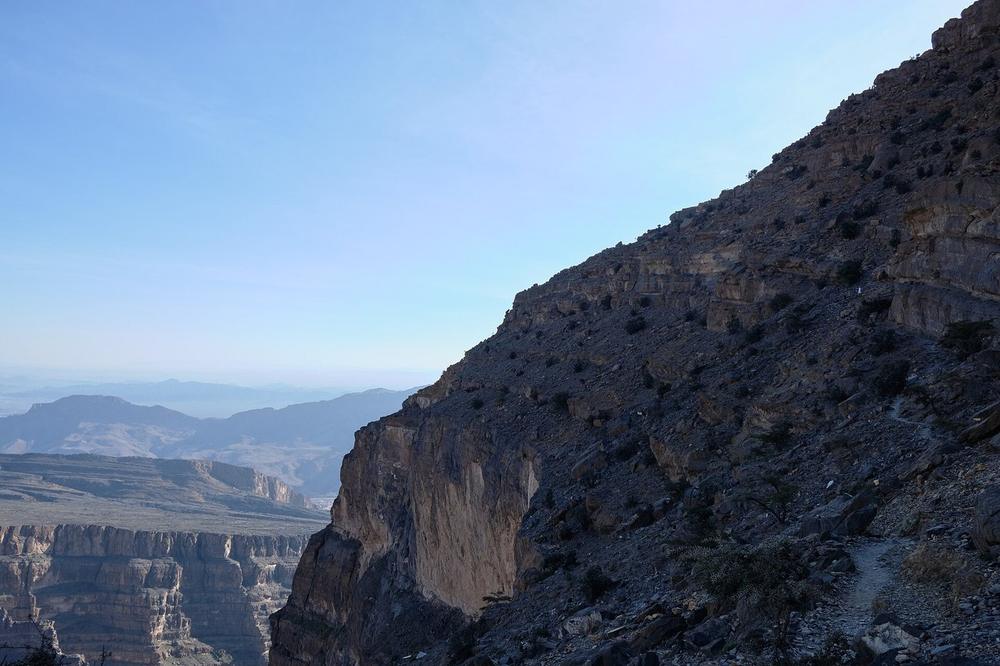
The road to Jebel Shams is tarmac and unremarkable until the final ascent to the summit plateau, which is gravel, steep, and the reason we are in a 4WD. Parking at the summit viewpoint costs 2 OMR. The Balcony Walk, the W6, leaves from the rim and follows a ledge above the canyon to an abandoned village at the end; there is no charge for the path itself. We walk it in the afternoon, when the canyon wall opposite is in shade rather than throwing heat back at you, and turn round at the village rather than pushing on.
Jebel Shams to the Wahiba Sands
First light at the rim, then the long transit of this journey: down the mountain, back past Nizwa, and east through Bidiyah to the edge of the Sharqiya Sands. It is about 230 km and three hours from Nizwa alone, so allow five hours in total with the descent and a stop.
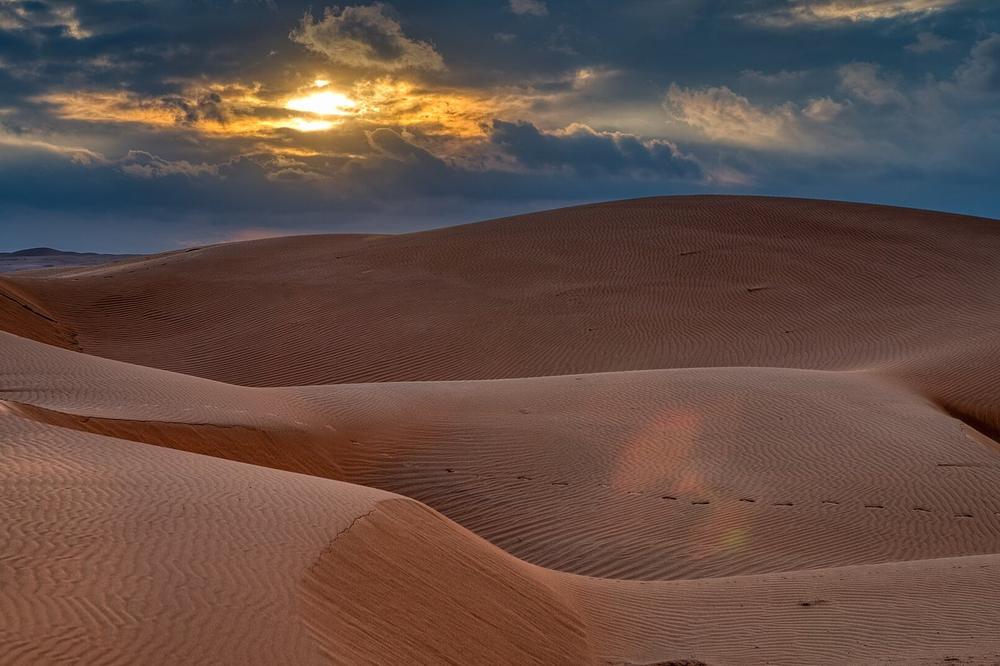
The Wahiba is not a national park and has no gate and no entrance fee. Access is through the camps: you leave the car at a petrol station on the edge and the camp sends a 4x4 over the first ridges. The dunes run north to south for a very long way and the camps sit a few kilometres in, which is far enough that the road noise stops.
The sands to Wadi Bani Khalid and Ras al Jinz
Out of the dunes in the morning and east to Wadi Bani Khalid, where a stream runs year round through a limestone gorge into a chain of pools. It is the busiest wadi in Oman at weekends and quiet on a weekday morning; the walk in is short and the rock is wet and polished, so it wants proper shoes rather than sandals.
On to Sur — about 174 km and two and a half hours from the sands — and then a further stretch of coast to Ras al Jinz. The turtle reserve runs two viewings: the night walk from 21:00, with arrival by 20:30, and the dawn walk from 05:00, with arrival by 04:45. Tickets are 12 OMR for an adult, 6 OMR for a child of 6 to 12 and free below that, and they must be booked ahead. This is a research station rather than a show. The guides control the light and the distance, nobody uses a flash, and on a bad night you see two turtles instead of ten.
Ras al Jinz to Sur
The dawn viewing at 05:00 is optional and about half of our travellers take it; the turtles returning to the water at first light are easier to watch than the ones coming ashore at night. Breakfast afterwards, and a slow morning.
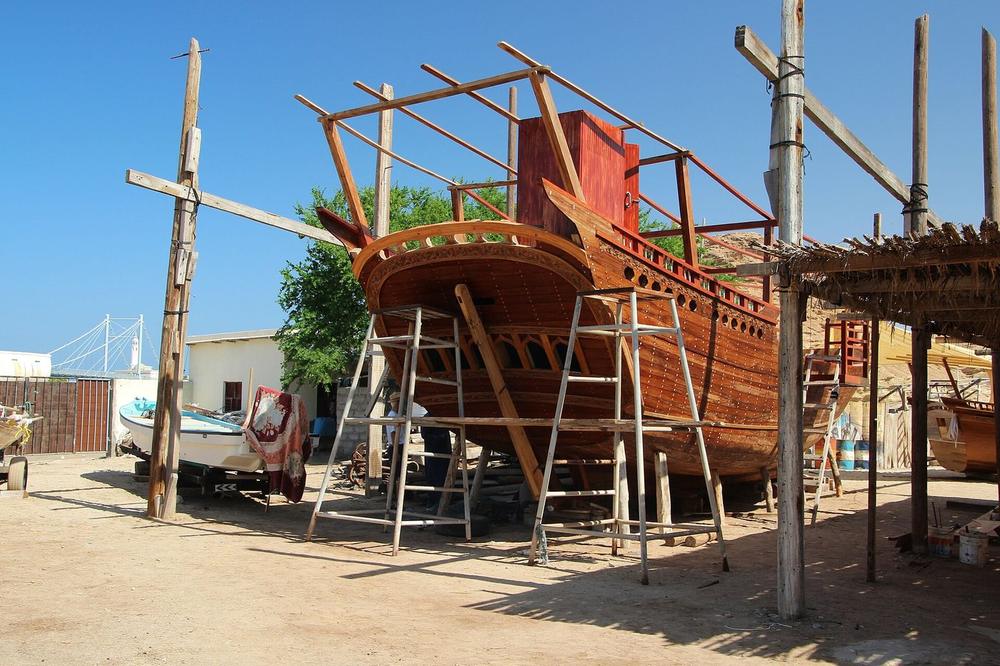
Sur built the ocean-going dhows that took Omani trade to Zanzibar and the Malabar coast, and two yards still build them by eye, without drawings. Across the lagoon, reached by the footbridge or by a small ferry, Ayjah is a quarter of blue-doored houses and a watchtower. The afternoon is free, and in a ten-day journey a free afternoon is not a gap in the planning.
Sur to Muscat along the coast
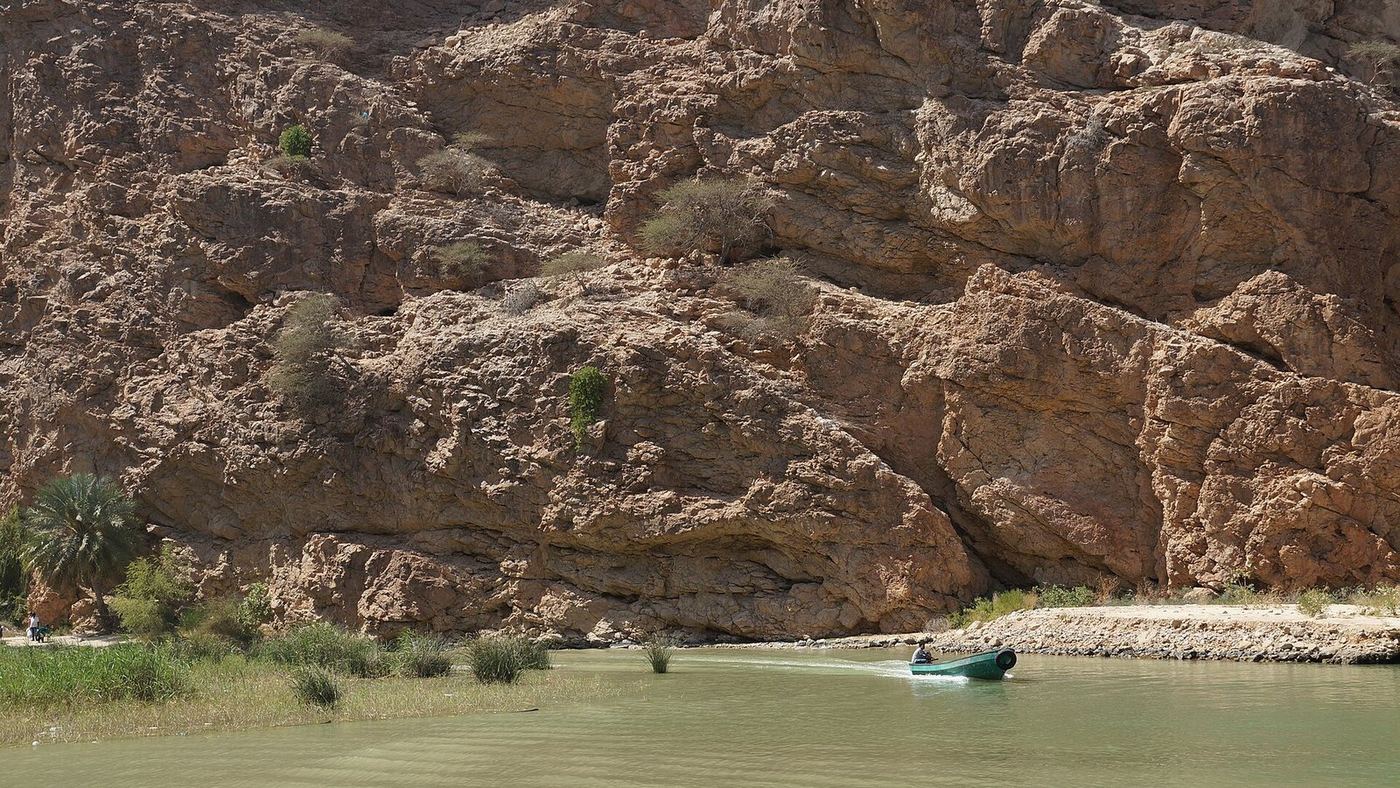
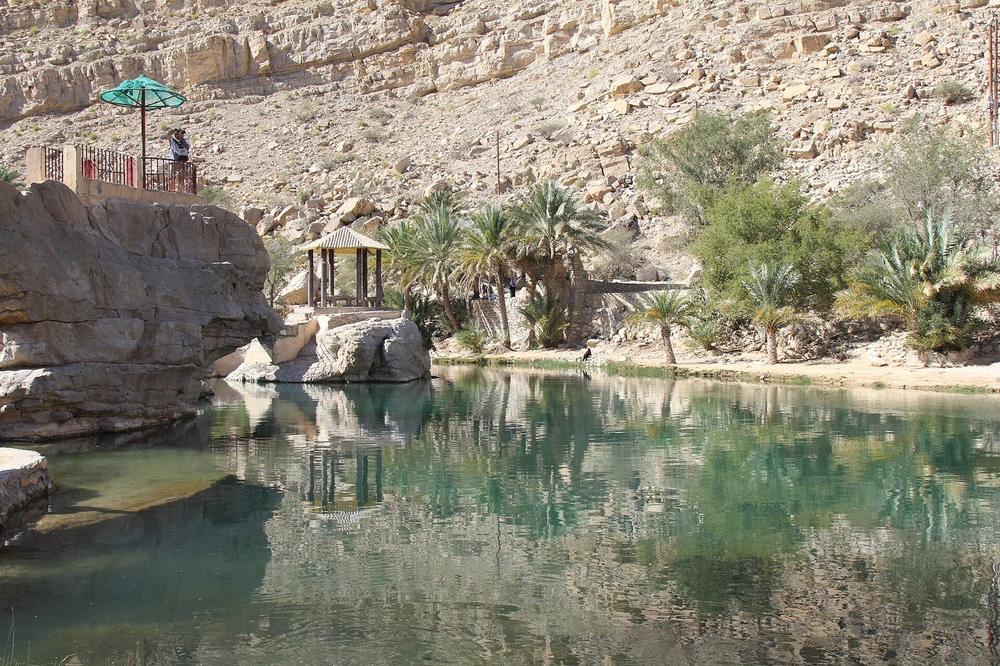
The coast road back is the best driving day of the loop and it holds two stops. Wadi Shab first, early: a boatman takes you across forty metres of water at the mouth for a small cash charge, and then the path runs upstream for the better part of an hour over loose rock and between date palms to a chain of pools. The cave at the end is reached by swimming through a gap in the rock, and there is no dry way to it, so this is a swim or a look.
The Bimmah sinkhole is twenty minutes further on, signposted, busy at weekends and free. Into Muscat in the middle of the afternoon, which leaves the evening for the souq if you left the shopping until now, or for nothing at all.
Depart Muscat
Breakfast, then 30 to 40 minutes to the airport with a margin for the coast road. Late departures get a day room rather than a hotel lobby.
What it costs
| Party size | Comfortable | Considered |
|---|---|---|
| 2 travellers | USD 5,300 | USD 7,200 |
| 3 – 4 | USD 4,400 | USD 6,000 |
| 5 – 8 | USD 3,900 | USD 5,300 |
Two people carry one 4WD and one driver-guide between them, and that is where the difference between the columns comes from. The two-traveller price is 36% above the same journey for five; season and hotel grade move the number far less.
Comfortable is good four-star in Muscat, the better mountain hotels on the Saiq plateau and at the Jebel Shams rim, a proper desert camp with a private bathroom, and the scientific centre at Ras al Jinz, which has no grade at all and is the only place to sleep on that beach. Considered is the five-star resorts in Muscat and the cliff-edge properties on the Jebel Akhdar, which are genuinely better and priced accordingly — and the same rooms as Comfortable at Ras al Jinz and in the dunes, because there is nothing above them and we will not pretend there is.
Oman sits in our second country tier, USD 340 to 460 per person per day for a party of four. The full breakdown of what a day on the ground costs before any margin is on the prices page.
What is and is not included
What the price includes
- Nine nights as listed, named by property in your quote
- A private 4WD and an English-speaking Omani driver-guide throughout
- The 4x4 transfer between the road and your desert camp, both ways
- Ras al Jinz turtle reserve tickets at 12 OMR an adult, booked in advance, for the night viewing
- The 2 OMR parking at the Jebel Shams summit viewpoint and all other entrance fees listed above
- Meals as listed day by day, and cold drinking water in the vehicle
- A local phone number that is answered at night, for the whole ten days
What it does not include
- International flights into and out of Muscat
- Visas. Most Western passports enter free for 14 days, which covers this journey; a longer stay needs the e-visa
- Travel insurance, which we require and do not sell
- The Ras al Jinz dawn viewing on day 8, which is a second ticket
- The via ferrata at Jebel Shams, about 25 OMR a person including equipment, if you want it added to day 5
- The boatman at Wadi Shab, a small cash charge paid at the water
- Lunches and dinners not listed, all drinks, and tips
The journey in pictures
Who this journey is wrong for
- Anyone travelling between June and August. Interior Oman passes 38°C in June and stays there; the wadis stop being a pleasure and the dunes stop being survivable in daylight. We do not sell this route in those months at any price. The Jebel Akhdar is the one exception, and two nights of mountain air is not a ten-day journey.
- Travellers who will not do the Jebel Shams balcony path. It is level rather than steep, but it runs along an unfenced ledge with a long drop on one side, and a day at the rim without it is a car park with a view.
- Anyone who wants a beach holiday attached. The Muscat coast has good hotels, but this itinerary sleeps at 2,000 metres, in a tent and at a research station in the same week, and adding four days of sea at the end works far better than trying to blend the two.
- Anyone who needs the advisory to be someone else's problem. Oman is at Level 3 on the US list as at September 2026, insurers are asking questions about the region, and if reading that sentence has already decided it for you, that is a reasonable place to land.
- Travellers who want alcohol with dinner every night. It is served in hotels and licensed restaurants and almost nowhere else, and there is none at the desert camp or at Ras al Jinz unless you carry it in.
How this compares with our other West Asia journeys
| Journey | Days | Countries | From |
|---|---|---|---|
| Oman | 10 | Oman | USD 3,900 |
| Jordan | 9 | Jordan | USD 3,300 |
| Jordan and Oman | 16 | Jordan, Oman | USD 6,300 |
| Uzbekistan | 10 | Uzbekistan | USD 2,700 |
Jordan and Oman are the two obvious halves of one region and they connect through the Gulf hubs in an afternoon, which is why the sixteen-day voyage exists. What the sixteen days buy is not more of the same: Jordan is archaeology and Oman is landscape, and running them together is the clearest way to see how different two neighbouring Arab countries can be.
If you want the country rather than the route, the Oman destination page covers seasons, nights and what a day on the ground costs, without selling you anything.
Tell us your dates
Send the month, the number of travellers and anything fixed at either end. A first draft itinerary comes back within two working days, and we will tell you in the same message if we think the month is wrong.
Questions travellers ask most
Oman is at Level 3 on the US advisory. What does that actually mean for this trip?
It means the US State Department, in an update dated 30 August 2026, asks Americans to reconsider travel to Oman, citing the regional conflict that began on 28 February 2026, the drone and missile risk that followed it, and a terrorism risk to tourist sites, transport hubs and markets. The only Level 4, Do Not Travel, area is the Yemen border, which this route does not approach.
We are not going to tell you the advisory is overblown, and we are not going to tell you what risk is acceptable for your family. What we will say is what we do: refundable rates wherever they exist, a deposit that moves to another date or another country until 45 days out, a full refund rather than a credit note if we stand a departure down, and a rule that we do not run a journey we would not send our own people on.
Two practical consequences worth knowing before you book. Some insurers now price or exclude cover in this region against government advice, so check your policy wording rather than the summary page. And Gulf airspace has been closed at short notice more than once this year, so build a spare day at the front of any onward connection that matters.
Do we need a visa, and does the ten-day length matter?
Most Western passports enter Oman free of charge for up to 14 days, so a ten-day journey needs no visa and no application. Nothing to pay, nothing to file.
Beyond 14 days you need the e-visa through the Royal Oman Police portal, which wants six months of passport validity, proof of return travel, a hotel booking, insurance and evidence of funds. If you are adding days at either end, tell us at the enquiry stage rather than after the quote, because it changes the paperwork rather than the price.
Could we come in the summer instead?
Not on this route. June is the hottest month and the interior runs past 38°C through June, July and August. The wadis are hot water in hot rock, the dunes are impossible in daylight, and the balcony path at Jebel Shams becomes a medical question rather than a walk. We do not sell these months here.
Two summer options do exist and neither is this journey. The Jebel Akhdar holds roughly 18 to 26°C all summer and works as a mountain stay of three or four nights. And Salalah, in the far south, has its khareef from about July to early September, when the monsoon turns the hills green and the country goes there on holiday. Ask us about either; do not ask us to fit them into this loop.
October to March is the window this itinerary is built for: roughly 25 to 35°C in the day, cool nights, very little rain. Note that Ramadan is expected to begin around 8 February 2027, with Eid al-Fitr in early March. Hotels and tourist restaurants serve as normal, but daytime eating in public is restrained, some site hours shift, and Eid brings a domestic travel spike.
Do we need four-wheel drive, and can we drive ourselves?
The Muscat, Nizwa, Wahiba and Sur circuit is entirely driveable in an ordinary saloon car on tarmac. Four-wheel drive is required for exactly two things: the final ascent onto the Jebel Shams summit plateau, which is gravel and steep enough to strand a sedan, and any movement over the dunes, which your desert camp handles with its own vehicle.
Self-drive is a real option in Oman and plenty of people do it well. What you lose is the driver-guide, and on this route that is most of the value: the reason a falaj is divided the way it is, which of the two dhow yards at Sur will let you inside, and the phone call that gets the Ras al Jinz booking moved when your flight lands late. Our price is built around one vehicle and one person who knows the ground, for all ten days.
Read next
Tell us about the journey you have in mind
Dates, party size and the places you care about are enough to start. You get a draft route and an indicative price, not a brochure.