Four Silk Road cities, nine nights, one party
Tashkent to Khiva along the line the caravans took, using the Afrosiyob for the fast legs and a car for the desert. Three nights at Samarkand, because two is not enough for it.
At a glance
- Duration
- 10 days, 9 nights
- Party
- Private, 2 to 8
- Starts
- Tashkent
- Ends
- Khiva
- Difficulty
- Easy
- From
- USD 2,700
Uzbekistan runs east to west along a line of oasis cities, and the whole country is arranged so that you travel in one direction and never double back. This route follows that line: Tashkent, Samarkand, Bukhara, Khiva, then out of the airport at Urgench. Nobody returns to the capital, and nine nights buy four cities rather than three cities and a transfer day.
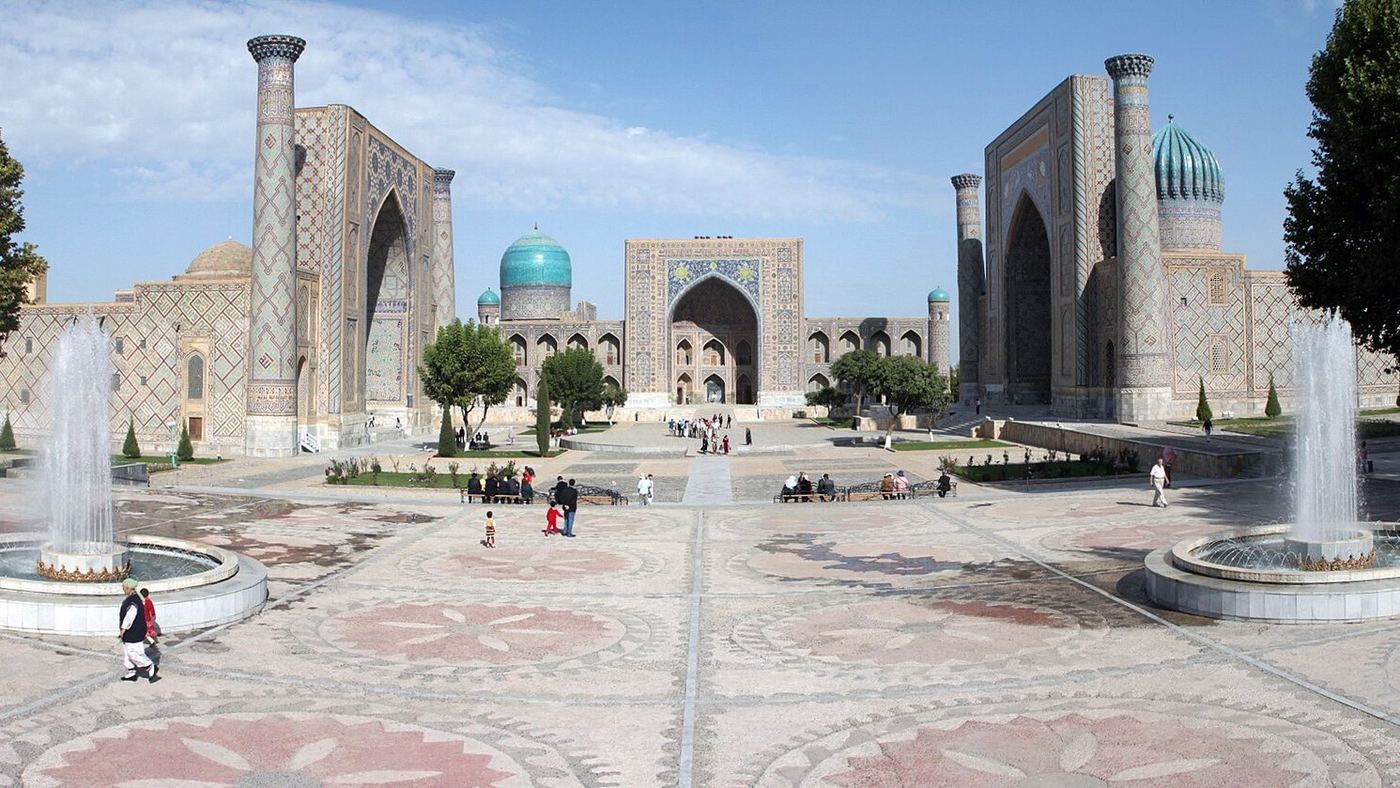
Three of those nights go to Samarkand. That is the decision most itineraries get wrong. Two nights covers the Registan, Shah-i-Zinda and Gur-e-Amir at a march; the third night is what buys the Ulugh Beg observatory, the paper workshop on the Siyob and a second evening on the Registan square when the coach parties have gone back to their hotels.
Everything here is brick, tile and open ground. If you want mountains, rivers or wildlife, this is the wrong journey and the sixteen-day Silk Road voyage, which carries on into the Kyrgyz ranges, is the right one.
Day by day
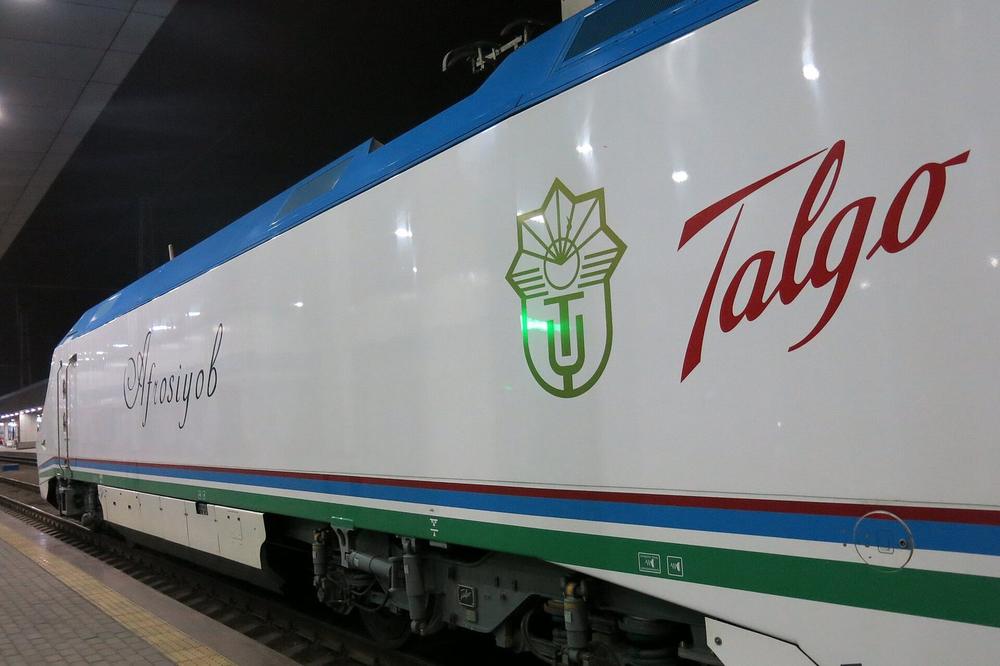
The Afrosiyob is a Talgo high-speed service running at up to 250 km/h, and it covers Tashkent to Samarkand in about two and a half hours. Booking opens 60 days before departure and seats can go within hours of opening, partly because operators take block allocations. This is why we ask for your dates early. If the train is full when you come to us, the leg becomes a long car transfer across the steppe, and we would rather you knew that before you paid a deposit than after.
Arrive Tashkent
Met at the airport and driven in. Most European arrivals land at an uncivilised hour, so the day is deliberately empty and the room is held from the night before your arrival date where the hotel allows it.
Tashkent is not what people come to Uzbekistan for and it repays a day anyway. An earthquake levelled the centre in 1966 and the Soviet Union rebuilt it as a showpiece, which is why the capital looks nothing like the three cities that follow.
Tashkent
The morning is Khast Imam, where the Uthman Quran is kept — one of the oldest surviving manuscript copies anywhere, and a queue-free ten minutes if you are there at opening. Then Chorsu bazaar under its blue dome, which is a working market and not a display: bread, dried apricots, horse sausage, and the sound level of a market that has been there for centuries.
The afternoon is the metro. Photography was banned in it until 2018, which is why so few travellers know that the stations are chandeliered, tiled and themed, and riding four or five of them is a better hour than most museums in the city.
Tashkent to Samarkand on the Afrosiyob
Morning train, about two and a half hours, and the difference between this and the road is most of a day. Economy fares run around 311,000 som, business around 455,000 som and the VIP saloon around 709,000 som at 2026 prices; we book business as standard because the seat pitch matters on a train this full.
The Registan in the late afternoon. Three madrasas on three sides of a square that was the civic centre of Timur's empire and was still a grain market in the nineteenth century. Go in the last hour of light rather than at midday: the tile is glazed and it throws the low sun back at you.
Samarkand
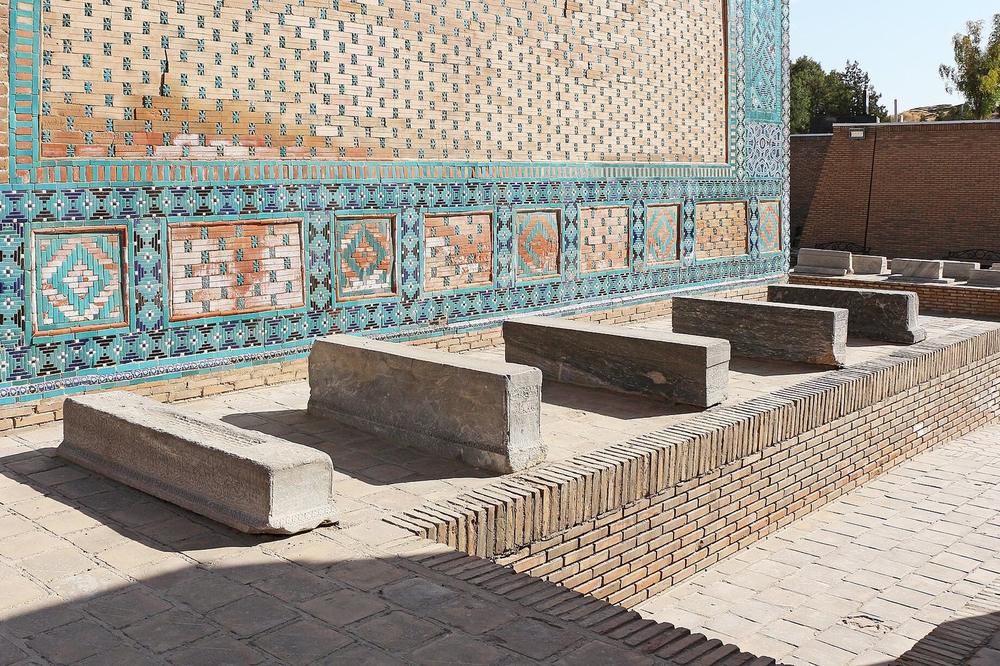
Shah-i-Zinda at opening. It is a lane of tomb chambers climbing a hillside, each face tiled by a different hand across three centuries, and it is narrow enough that forty people turn it into a corridor. Being there first is the whole point.
Then Bibi Khanym, which was built too fast and too large and began falling down within the builder's lifetime, and Gur-e-Amir, where Timur is buried under a slab of dark jade. The afternoon is the Ulugh Beg observatory: what survives is the buried arc of a sextant cut into rock, used by an astronomer prince to measure the year to within a minute of the modern figure.
Samarkand, at your own speed, or over the pass
A free day with two arguments for how to spend it. Staying put: the Afrosiyob site on the edge of town, where the pre-Mongol city stood and where the seventh-century ambassadors' fresco is kept, and the paper workshop at Konigil, which makes mulberry-bark paper the way it was made here before the craft reached Europe.
Going out: Shakhrisabz, over the mountains to the south, where Timur was born and where the gate of his palace still stands at a scale nothing else in the country matches. It is a full day and a mountain road, and in early April the pass can still hold snow.
Samarkand to Bukhara
West by train where the timetable allows and by car where it does not; either way it is a morning, and the country in between is cotton, canals and flat light. Bukhara in the afternoon, starting at Lyab-i-Hauz, the pool the old town is arranged around, under mulberry trees that are older than most of the buildings facing them.
Bukhara is the one city on this route where the monuments are not set apart from the town. People live in it. The trading domes still trade, mostly in scarves and knives now rather than in silk and books, and you walk between sights rather than driving.
Bukhara on foot
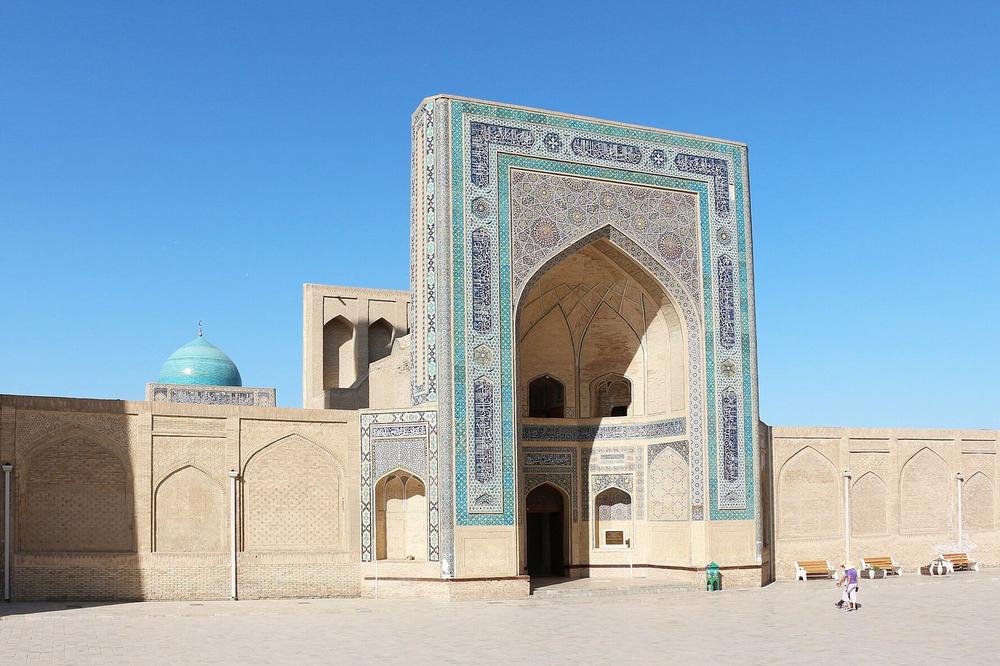
The Kalyan minaret is the thing Genghis Khan is said to have spared, and it has stood over the city since the twelfth century. Around it: the Kalyan mosque, the Mir-i-Arab madrasa which is a working seminary and not open to visitors, and the Ark, the fortress the emirs ruled from until 1920.
The Samanid mausoleum in the park to the west is the oldest thing here and the best, a cube of patterned brick from the tenth century that survived because it was buried in silt for several hundred years. Late afternoon at Sitorai Mokhi Khosa outside town, the last emir's summer palace, which is where Bukhara stops being medieval and turns into a Russian province.
Bukhara to Khiva across the Kyzylkum
The long day of this journey, and there is no way to make it short. The road runs northwest across the Kyzylkum, the red sand desert, with the Amu Darya on one side for part of it and nothing at all on the other. Lunch is at a roadside place chosen for the fact that it is the only one, and the tea is better than the food.
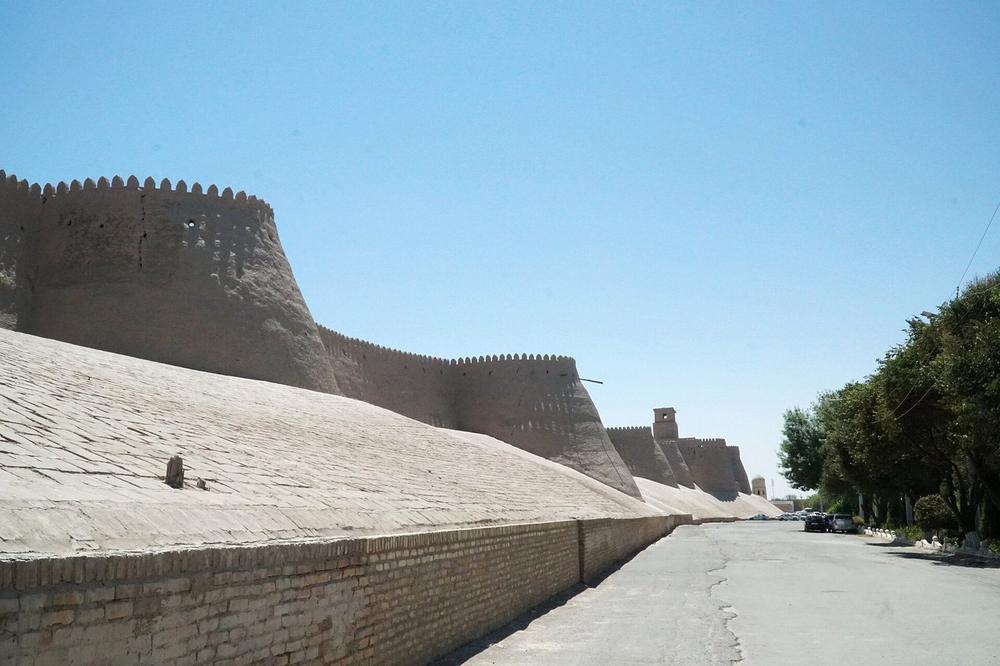
Khiva appears as a wall in the middle of irrigated fields. You go inside it and stay inside it: the hotel is within the Ichan Kala, so the walled city is yours after the day visitors leave at five.
Khiva
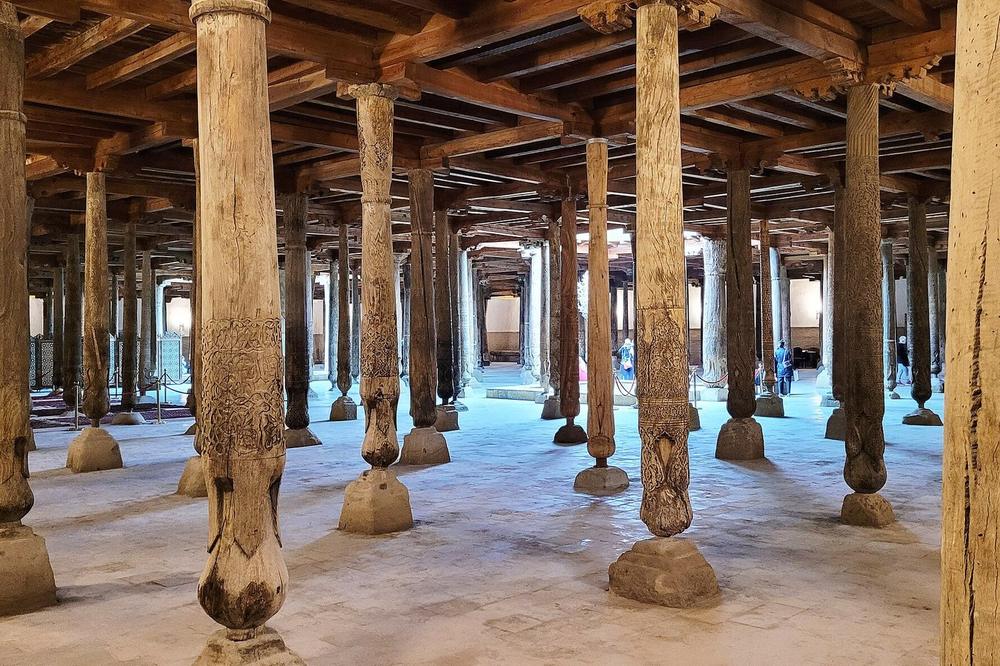
The whole walled city is the museum and it takes a morning to cross properly: the Kalta Minor, the fat turquoise minaret that was abandoned unfinished, the Juma mosque with its forest of carved wooden columns and its single hole of light in the roof, and the Islam Khoja minaret, which can be climbed by a dark spiral stair if you are neither tall nor claustrophobic.
The afternoon is free and most people spend it on the wall walk or in the silk-carpet workshop, where the dyes are still made from madder, indigo and pomegranate rind. Khiva is smaller and more restored than Bukhara, and it is fair to say some of it is reconstruction. It is also the only one of the four you can walk out of your hotel at six in the morning and have entirely to yourself.
Depart Urgench
Breakfast, then the drive across the irrigated plain to Urgench airport for the flight to Tashkent or a regional connection. Departures from here are thin on the ground, so the last night is set by the flight and not the other way round.
What it costs
| Party size | Comfortable | Considered |
|---|---|---|
| 2 travellers | USD 3,650 | USD 4,950 |
| 3 – 4 | USD 3,050 | USD 4,150 |
| 5 – 8 | USD 2,700 | USD 3,650 |
Uzbekistan is one of the least expensive countries on this site to travel well in, and the reason a party of two pays about a third more per head than a party of five is the same everywhere: the car and the guide cost what they cost whether two people or six are using them.
Comfortable here means the converted courtyard houses in the Bukhara and Khiva old towns, which are the best beds in those cities regardless of budget, and solid four-star in Tashkent and Samarkand. Considered buys the international-brand hotels in the two big cities and the largest rooms in the small ones. There is no five-star inside the walls at Khiva and we will not pretend there is.
One thing this page does not do is quote entrance prices for the Registan, Shah-i-Zinda or the Bukhara monuments. Our researchers could not obtain a current official figure from an Uzbek government source, and we would rather leave a gap than print a number a blog invented. Every entrance on the itinerary is included in your quote at the rate we actually pay. The wider picture of what a day costs across Asia sits on the prices page.
What is and is not included
What the price includes
- Nine nights as listed, named by property in your quote
- Afrosiyob seats on the Tashkent–Samarkand leg, booked at the 60-day mark
- A private car and driver for every road leg, including the Kyzylkum crossing
- A national guide throughout, plus city guides in Samarkand, Bukhara and Khiva
- All entrances listed day by day, at the rate we pay
- The transfer to Urgench airport on the final morning
- Meals as listed, and drinking water in the vehicle
What it does not include
- International flights into Tashkent and out of Urgench or Tashkent
- The domestic Urgench–Tashkent flight, quoted separately because the fare moves with the season
- Travel insurance, which we require and do not sell
- Meals not listed above, and all drinks
- Tips, which are customary and never built into our prices
- Visas, which US, UK, EU and Australian passports do not need for 30 days
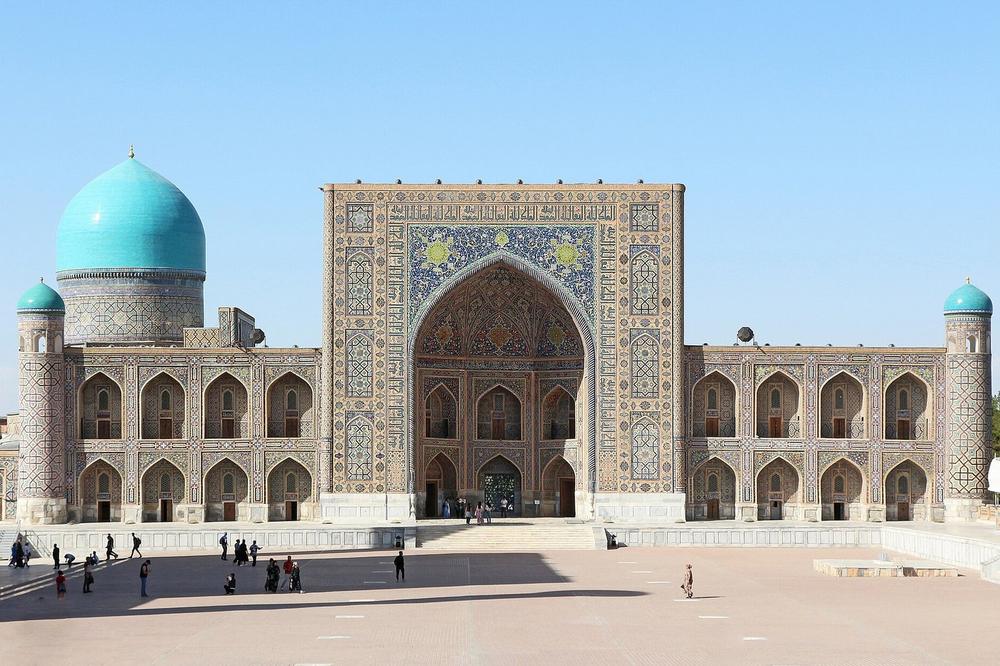
The journey in pictures
Who this journey is wrong for
- Anyone who wants landscape. Between the four cities there is cotton, canal and desert, and the desert is flat. The mountains are in Kyrgyzstan and Tajikistan, not here.
- Travellers who book late in a peak month. The Afrosiyob opens for sale 60 days out and sells hard; if we cannot get you seats, the Tashkent–Samarkand leg becomes a long road transfer, and April and October are exactly when that happens.
- Anyone travelling in July or August. Daytime temperatures run to around 40 degrees, the monuments are unshaded brick and tile, and the walk across the Ichan Kala at midday is genuinely unpleasant rather than merely warm.
- Anyone who needs variety at dinner. Restaurant food here is plov, kebab, samsa, bread and salad, done well and repeated. Vegetarians manage; vegans and people avoiding wheat find it hard outside Tashkent.
- Travellers with knees or hips that object to uneven ground. There are almost no lifts, the old towns are laid in worn brick, and the minarets and observatory steps have no handrail worth the name.
How this compares
| Journey | Days | Countries | From |
|---|---|---|---|
| Uzbekistan | 10 | Uzbekistan | USD 2,700 |
| Silk Road | 16 | Uzbekistan, Kyrgyzstan | USD 4,600 |
| Georgia and Armenia | 11 | Georgia, Armenia | USD 3,100 |
| Jordan | 9 | Jordan | USD 3,300 |
Ten days is the right length for Uzbekistan on its own. Sixteen is the right length if you want the country plus mountains and horses, which is what Kyrgyzstan adds and what this route deliberately leaves out. More on the country as a whole, and on which season suits which half of it, is on the Uzbekistan page and on when to go; the case for three nights rather than two in one city is made in detail on the Samarkand page.
Tell us your dates
Send the month and the number of travellers. If you are inside ninety days we will tell you straight away what the train situation looks like, because that shapes everything else.
Questions travellers ask most
Why does the Afrosiyob booking window matter so much?
Seats go on sale 60 days before departure and can sell out within hours of opening, partly because tour operators take block allocations the moment the window lifts. It is not a case of buying at the station on the day.
The service itself is a Talgo train running at up to 250 km/h and it covers Tashkent to Samarkand in about two and a half hours. The alternative is the road, which turns a morning into most of a day and arrives at Samarkand with the light already gone. Give us your dates before the window opens and this is a non-problem.
Do we need a visa, and how does Uzbekistan sit on the advisories?
US, UK, Australian and most EU passports enter visa-free for 30 days. There is no application, no fee and no arrival card to buy from a third-party site.
The US State Department has Uzbekistan at Level 1, exercise normal precautions — the lowest band there is, and the same level it gives most of western Europe. It is one of the more relaxed countries in Asia to travel in as a foreigner, and the practical annoyances are bureaucratic rather than anything else: hotels register you with the authorities, so keep the slips they give you until you have left.
Why will you not tell us what the Registan costs to enter?
Because we could not verify it against an Uzbek government source, and a price we cannot verify is a price we do not print. Several widely-copied figures are circulating on blogs and they disagree with each other.
Every entrance on this itinerary is included in your quote, so the number does not change what you pay us. If you want to know it before you travel, ask and we will tell you what our ground agent is paying that month.
Which months work, and is July really out?
April and May, then September and October. Those four months are why Central Asia has a short high season: warm days, cold-ish nights, and tile that has not been baking since dawn.
July can be done and we have run it, but daytime temperatures reach around 40 degrees and every major sight is an open courtyard. If summer is the only window you have, we shift the whole day earlier — out at six, back at eleven, out again at five — and we say plainly that it is a compromise rather than a clever trick.
Read next
Tell us about the journey you have in mind
Dates, party size and the places you care about are enough to start. You get a draft route and an indicative price, not a brochure.