Two countries, one mountain range, eleven days
Tbilisi and the Alazani valley, the Military Highway north to the mountain at Kazbegi, then south across the border into the Debed gorge, Lake Sevan and Yerevan.
At a glance
- Duration
- 11 days, 10 nights
- Party
- Private, 2 to 8
- Starts
- Tbilisi
- Ends
- Yerevan
- Difficulty
- Easy to moderate
- From
- USD 3,100
Three areas in these two countries carry Do Not Travel advice, and none of them is on this itinerary. South Ossetia and Abkhazia, both Russian-occupied, sit on Georgia's northern flank: unauthorised entry risks arrest, detention and fines, there are landmines near the administrative boundary lines, medical care is severely limited and no foreign government can assist there. The boundary lines are hard to identify on the ground, which is the specific danger for anyone walking in eastern South Ossetia. The Armenia–Azerbaijan border is the third, and the US advisory bars its own embassy staff from Gegharkunik east of Vardenis, Syunik east of Goris and Syunik south of Kapan.
This journey runs Tbilisi – Kakheti – Kazbegi – Tbilisi – Dilijan – Yerevan. The Kazbegi leg goes north on the Military Highway, which passes well east of the South Ossetian boundary; the Armenian half stays in the centre and west of the country, on the Yerevan, Garni, Geghard, Khor Virap and Lake Sevan circuit that the same advisory places outside the flagged areas. Georgia is at Level 1, Exercise Normal Precautions. Armenia is at Level 2, Exercise Increased Caution. Both figures are as at September 2026, and how we read advisory levels generally is set out on the advisories page.
Georgia and Armenia are not two versions of the same country and eleven days is roughly the point at which that becomes obvious rather than something a guide has to tell you. Georgia is greener, louder, wine-soaked and pointed at Europe. Armenia is drier, higher, harder, and built around a church that has held the nation together through several centuries when nothing else did. Put a border between them on day eight and the contrast does the teaching.
The route is deliberately not a straight line. The Georgian Military Highway runs north from Tbilisi to the Russian frontier and stops there, so Kazbegi is out and back: you sleep in Tbilisi again on night seven. That is not sloppy planning, it is the road network, and the alternative is dropping the one mountain the country is known for.
Everything here moves by car. There is no internal flight worth taking in either country and the single overnight train between the two capitals would cost you the Debed monasteries, which sit on the road it bypasses. Four of the eleven days involve three hours or more behind glass, and the driving is a real part of the journey rather than a tax on it.
Day by day
The crossing at Sadakhlo and Bagratashen is straightforward and it involves a change of vehicle. Your Georgian driver and guide take you to the line, you walk through the two posts with your luggage, and an Armenian driver and guide are waiting on the far side. Allow an hour. We have cleared it in twenty minutes and we have sat in it for two, and the day is built with enough slack that the difference does not cost you a monastery.
Arrive Tbilisi
Met at the airport and driven in, about twenty-five minutes. Most flights from Europe land at an unsociable hour, so nothing is scheduled for this day and the room is held from the night before wherever the rate allows it.
If you arrive in daylight, the walk to take is Rustaveli Avenue to Freedom Square and down into Sololaki, which is where the balconied houses are and where a fair number of them are being held up by scaffolding.
Tbilisi on foot
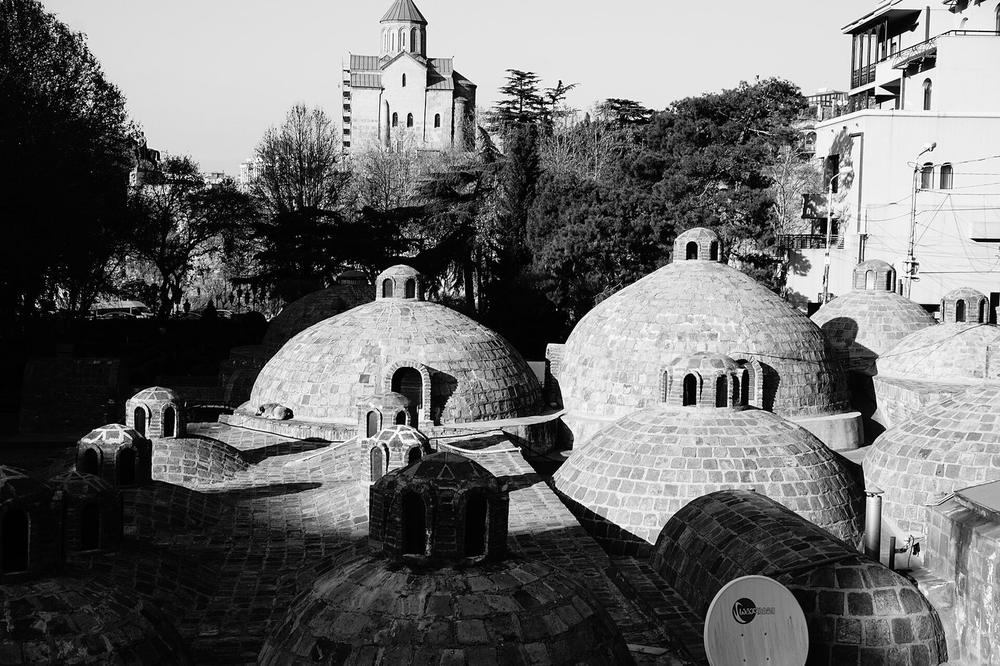
The old town in the morning: the Metekhi church on its rock above the Kura, the brick domes of the sulphur baths at Abanotubani, the mosque and the synagogue within a few minutes of each other, and the fortress on the ridge, reached by a cable car or by a steep twenty minutes.
The afternoon is the argument the city is having with itself. Nineteenth-century Tiflis, Soviet concrete and a good deal of new glass sit on the same streets, and not everyone here is pleased about the third of those. It ends at the Dry Bridge market, where Soviet medals, cameras and cutlery are sold by people who owned them.
Tbilisi into Kakheti
East across the Gombori range into the Alazani valley, with the Caucasus wall standing along the far side of it. Sighnaghi first, a walled hill town that was comprehensively restored in the 2000s and is either charming or overdone depending on the hour you arrive; go before the Tbilisi day trips and it is the former. Bodbe monastery is fifteen minutes below it.
On to Telavi and the valley floor for two nights. Allow about three hours of driving across the day, all of it on decent road.
The cellars, and how the wine is actually made
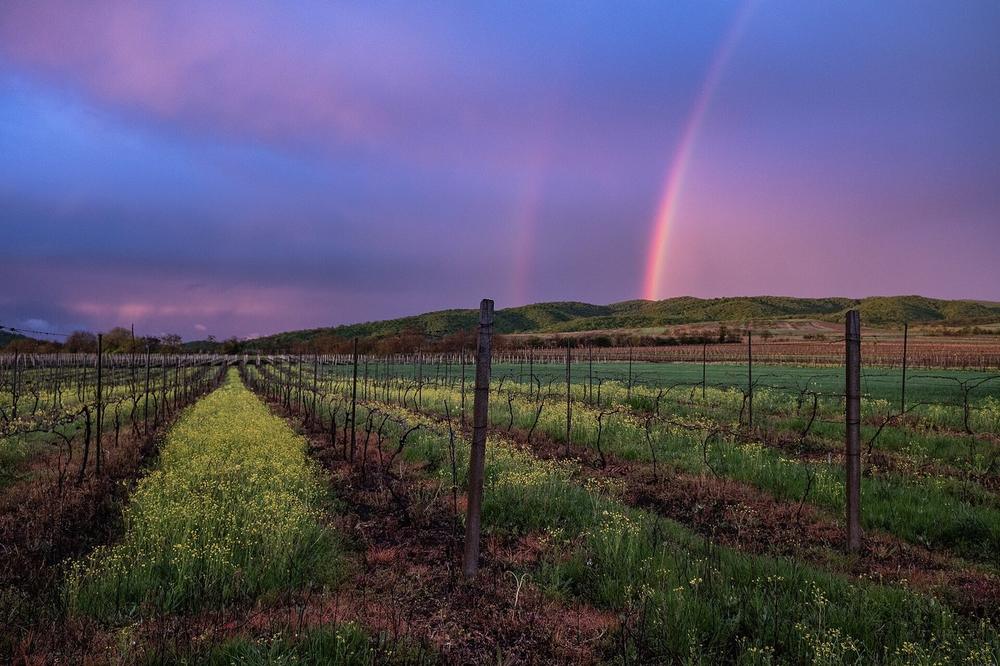
Two cellars, not five. The first is a family marani where the qvevri are buried to the neck in the floor and the wine ferments on skins and stalks through the winter, which is why Georgian white comes out amber and tastes like nothing in the French canon. The second is a modern estate working in steel and oak, because the interesting thing about Georgian wine right now is that both are being made a mile apart by people who argue about it.
Between them, Alaverdi cathedral on the plain and lunch at a table that will be too large. Supra rules apply: there is a toastmaster, the toasts have an order, and the correct response to a full glass is not to empty it every time.
Kakheti to Kazbegi on the Military Highway
The long drive of the journey and the best one. West out of the valley, then north on the road the Russians cut through the mountains in the nineteenth century: the fortress and churches at Ananuri above the Zhinvali reservoir, the ski town at Gudauri, and the Soviet friendship monument on its terrace above the valley, which is a mosaic drum on the edge of a very long drop.
Over the Jvari Pass and down to Stepantsminda, where the road continues to the Russian frontier and, for our purposes, ends. Allow five and a half hours with the stops. Lorries queue on the last stretch and there is no way round them.
Gergeti, and a valley
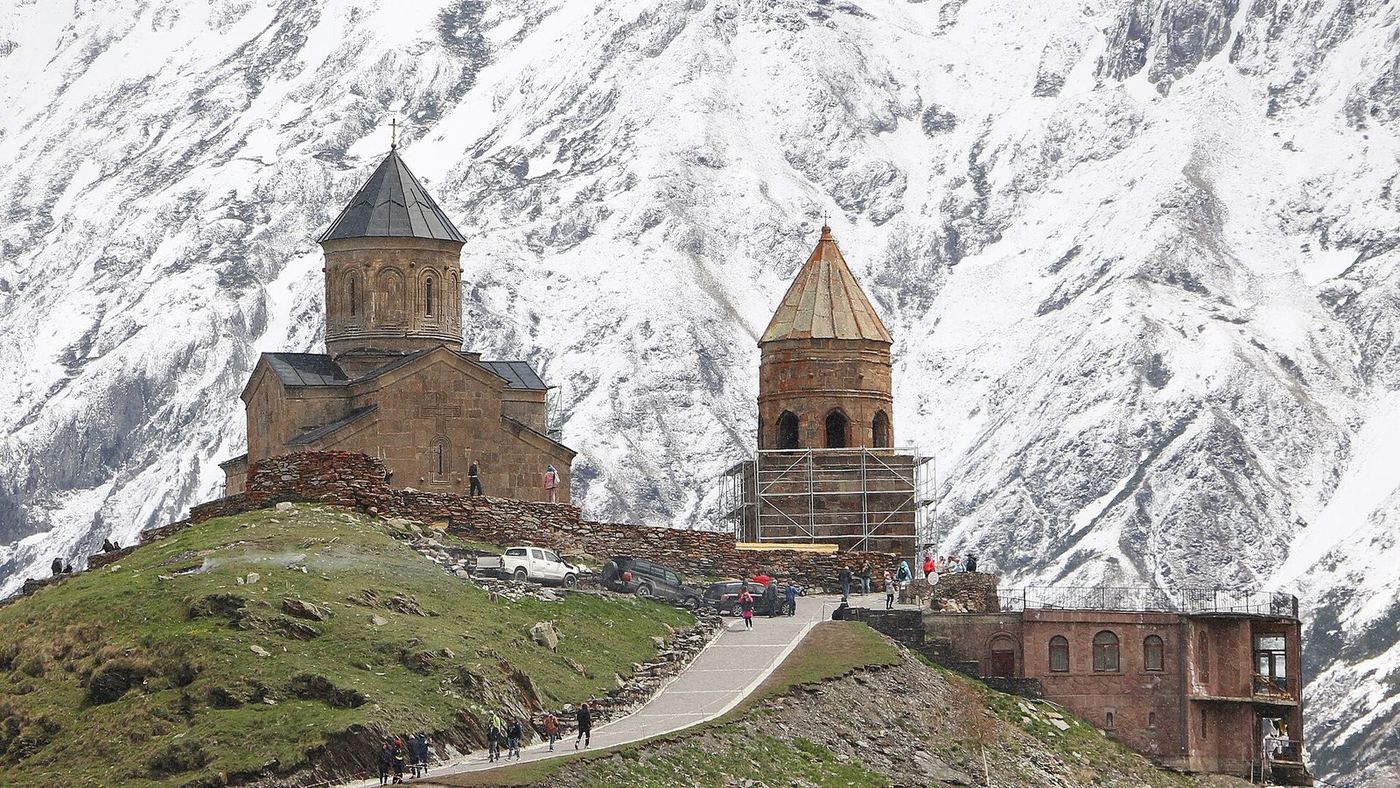
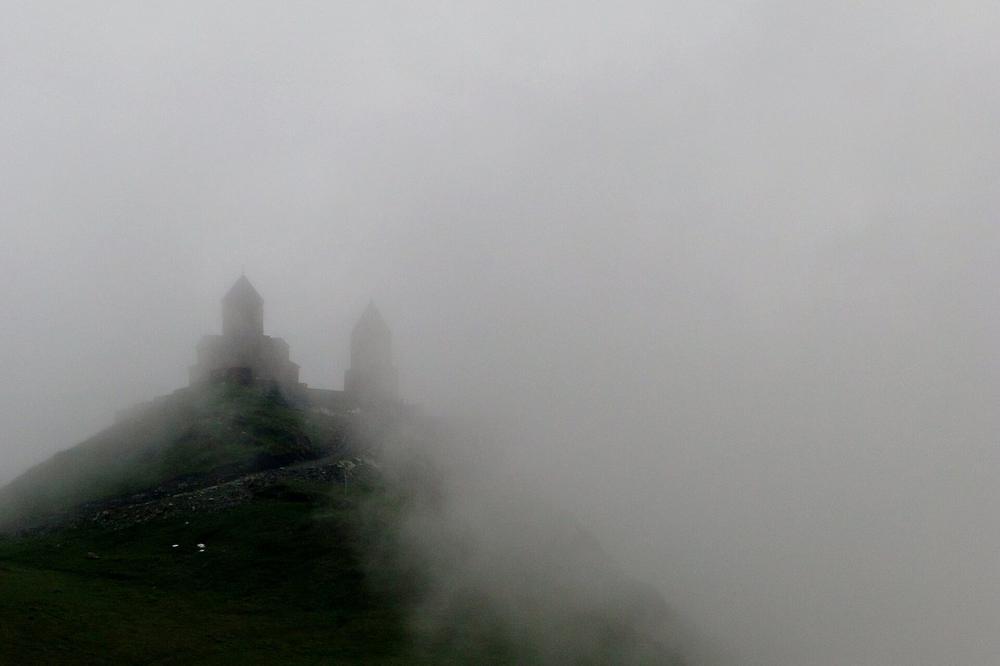
The Trinity church above Stepantsminda is the image every Georgian tourist board uses and it earns it. The track up is rutted and we take a local 4WD to the top and walk down, which is the right way round: an hour and a half of climbing in thin air before breakfast is a poor use of a mountain morning. Kazbek itself is behind the church and shows itself perhaps one morning in three, which is worth knowing before you build a photograph around it.
The afternoon takes one of two valleys. The Truso runs west past mineral springs, travertine terraces and abandoned towers, and is a flat walk in and back. Juta is higher, steeper and more of a mountain day. Your guide decides on the morning's weather rather than the day before.
Back down the highway, by way of Mtskheta
South again, and the same road looks different in the other direction. Mtskheta was the capital before Tbilisi was and is still the seat of the Georgian church: the Jvari monastery stands on a bare hill above the meeting of two rivers, and Svetitskhoveli cathedral sits in the town below it, inside its own wall.
Into Tbilisi in the late afternoon. This is a spare evening in a full itinerary and we leave it spare on purpose.
Into Armenia and the Debed gorge
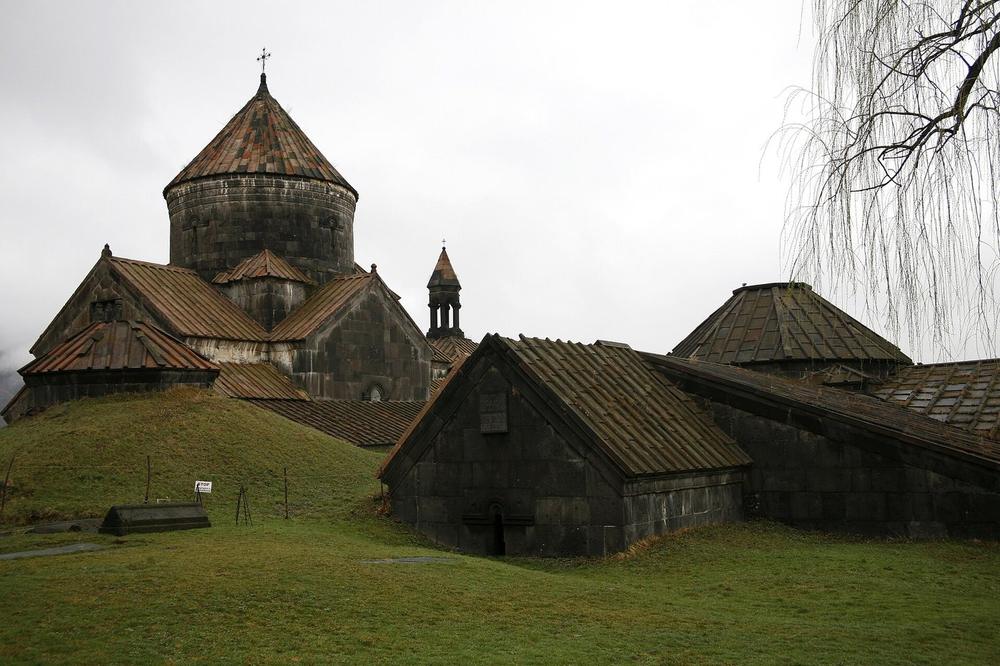
An hour south to the border, the crossing on foot, and then the road turns up the Debed gorge. Sanahin and Haghpat stand a few kilometres apart on opposite sides of it, built when this was the northern edge of the Armenian kingdom, and they are the first thing that tells you the two countries are not continuous: dark stone, low doors, khachkars cut like lace and set into the walls, and almost nobody there.
The road climbs on to Dilijan, in the one properly forested corner of a country that is otherwise bare rock, and the night is spent there or on the shore of Lake Sevan a short drive further.
Lake Sevan, Garni and Geghard, then Yerevan
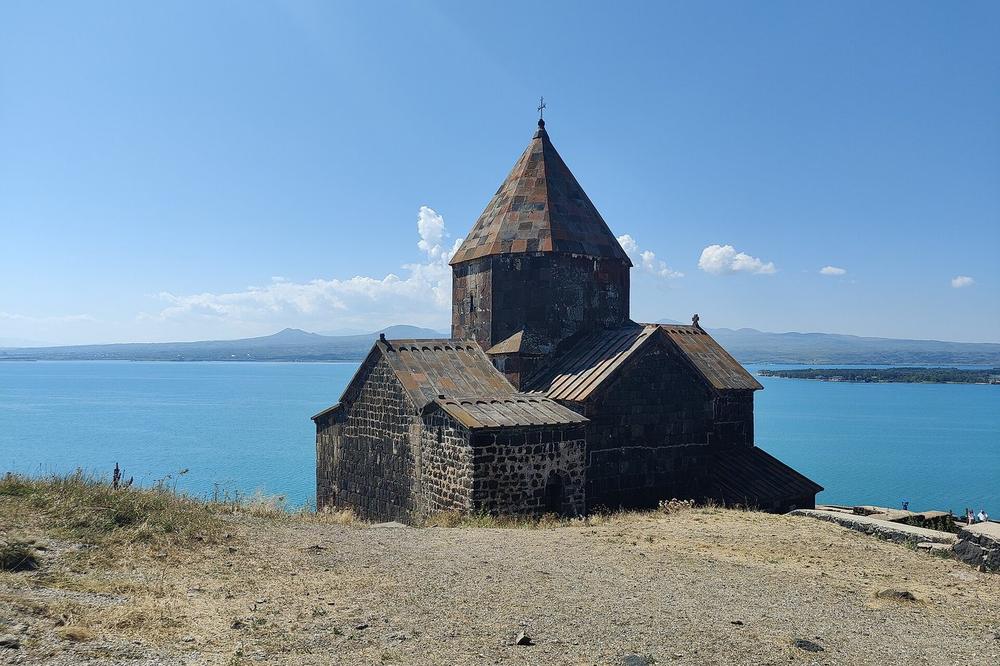
Sevanavank sits on what was an island until the lake was drained for irrigation and became a peninsula, and the steps up to it are the only exercise of the morning. The water is a colour that changes hour by hour and the lake is high enough that the wind off it is cold even in August.
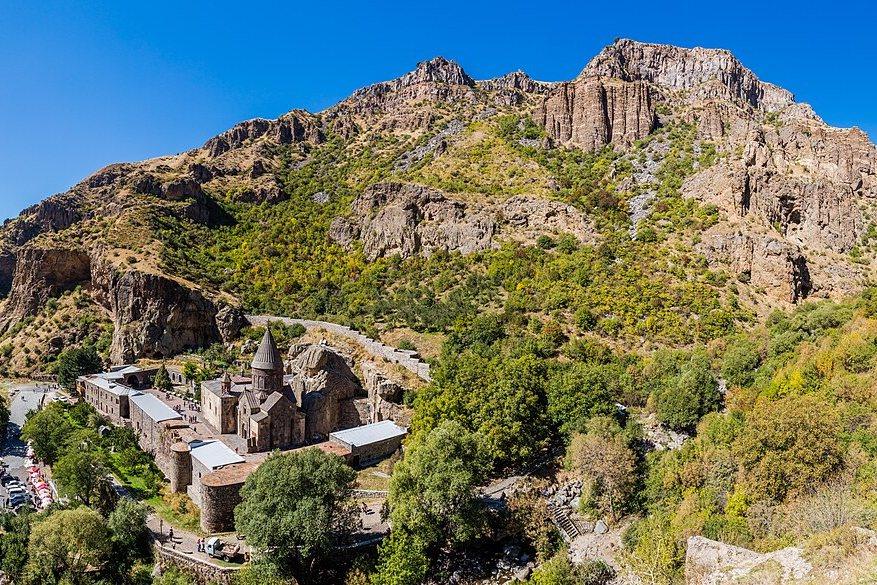
South to Garni, a colonnaded temple on a spur above the Azat gorge and the only building of its kind left in the region, then up the valley to Geghard, where the inner chambers are not built at all but cut into the cliff. Someone will usually be singing in the deepest one, and the room does the rest. Into Yerevan for the last two nights.
Yerevan, and the plain below Ararat
The morning is Tsitsernakaberd, the genocide memorial on the hill above the city, and its museum. It is not a comfortable two hours and it is not optional in any honest reading of this country; nothing else in Yerevan makes sense without it. Afterwards, deliberately, the Matenadaran, which holds the manuscripts that survived, and lunch somewhere unhurried.
The afternoon goes to Khor Virap on the plain, a monastery on a low hill with Ararat filling the sky behind it, on the other side of a border that has been shut for decades. It is the single most Armenian view in Armenia and the reason is not architectural. Back for a last evening on the Cascade steps.
Depart Yerevan
Breakfast, then twenty minutes to Zvartnots. Most departures for Europe leave in the very early morning, so in practice this is a night flight out of day ten and we hold the room until you go.
What it costs
| Party size | Comfortable | Considered |
|---|---|---|
| 2 travellers | USD 4,200 | USD 5,700 |
| 3 – 4 | USD 3,500 | USD 4,750 |
| 5 – 8 | USD 3,100 | USD 4,200 |
There are two cars and two guides on this journey, one set in each country, and a party of two carries both of them alone. That is why the two-traveller column runs 36% above the same eleven days for a party of five. Hotel grade moves the number by far less, and the season barely moves it at all outside August.
Comfortable is good four-star in Tbilisi and Yerevan and the best small hotels elsewhere: a wine estate in the Alazani valley, a mountain-facing hotel at Stepantsminda, a family-run place in Dilijan. Considered is the five-star properties in the two capitals, which are genuinely better, and a materially better room in Kakheti and at Kazbegi — but the same hotel in Dilijan, because there is nothing above it and inventing a grade does not create one.
Georgia and Armenia both sit in our third country tier, USD 250 to 360 per person per day for a party of four. What that day actually buys, before any margin, is broken down on the prices page.
What is and is not included
What the price includes
- Ten nights as listed, named by property in your quote
- A private car and driver in Georgia, and a second private car and driver in Armenia
- A Georgian national guide for days 1 to 8 and an Armenian national guide for days 8 to 11
- The local 4WD up to Gergeti Trinity on day 6
- All entrance fees for the sites listed day by day, and the two cellar visits in Kakheti with tastings
- Meals as listed day by day, including the supra lunch on day 4
- Assistance at the Sadakhlo and Bagratashen crossing on both sides
What it does not include
- International flights into Tbilisi and out of Yerevan
- Georgian entry, which is free for most Western passports
- Armenian entry, which is visa-free for some passports and an e-visa for others, and which we check per traveller against the official eligibility checker
- Travel insurance, which we require and do not sell
- Lunches and dinners not listed, all drinks outside the tastings, and tips
- Any wine you buy at a cellar and want shipped home
The journey in pictures
Who this journey is wrong for
- Anyone who wants to unpack once. You change bed five times in ten nights and one of those changes is a return to a city you have already slept in, because the Military Highway is a dead end at the Russian frontier.
- Travellers who dislike long days in a car. Day 5 is five and a half hours, days 7 and 8 are three and a half and five, and there is no flight and no useful train that shortens any of them.
- Anyone booking the deep winter and still expecting Kazbegi. The high roads here are seasonal, no roads authority publishes a fixed calendar for them, and the pass above Gudauri can shut for a day or two at a time after snow. We will run a winter version, but the mountain half of it is written in pencil.
- Anyone who wants Azerbaijan in the same trip. The Armenia–Azerbaijan border carries Do Not Travel advice and we will not route across it; Baku from Yerevan means flying back through Tbilisi or Istanbul, and doing it properly needs four more days rather than two.
- Travellers who need a five-star bed every night. The two capitals have them. Stepantsminda, Dilijan and the Alazani valley have good small hotels run by families, and that is the ceiling in those three places.
How this compares with our other journeys in the region
| Journey | Days | Countries | From |
|---|---|---|---|
| Georgia and Armenia | 11 | Georgia, Armenia | USD 3,100 |
| Uzbekistan | 10 | Uzbekistan | USD 2,700 |
| Silk Road | 16 | Uzbekistan, Kyrgyzstan | USD 4,600 |
| Oman | 10 | Oman | USD 3,900 |
The Caucasus and Central Asia get filed together and they should not be. This journey is churches, mountains and wine in two Christian countries with a European posture; the ten days in Uzbekistan are Islamic architecture and desert cities on the old trade road, and the Uzbekistan destination page sets out what that country is before any itinerary is attached to it.
Choosing between them on months rather than taste is also reasonable. The Caucasus mountain season is short and Central Asia peaks in spring and autumn; the month-by-month page lays the whole of Asia out side by side.
Tell us your dates
Send the month, the number of travellers and anything fixed at either end. A first draft itinerary comes back within two working days, and if the month does not suit the mountains we will say so in the same message.
Questions travellers ask most
What are the advisory levels, and are any of the flagged areas near this route?
As at September 2026 Georgia is at Level 1, Exercise Normal Precautions, on the US State Department list, and Armenia is at Level 2, Exercise Increased Caution. Those are the two lowest of the four bands.
Three areas carry Do Not Travel advice and this itinerary goes to none of them. South Ossetia and Abkhazia are Russian-occupied regions on Georgia's northern flank, where unauthorised entry risks arrest and fines, landmines are reported near the administrative boundary lines and no foreign government can help you. The Armenia–Azerbaijan border is the third; the same advisory keeps US embassy staff out of Gegharkunik east of Vardenis, Syunik east of Goris and Syunik south of Kapan.
Our route runs Tbilisi, Kakheti, Kazbegi, Tbilisi, Dilijan and Yerevan, with day trips to Garni, Geghard, Sevan and Khor Virap. The advisory itself places that circuit outside the flagged areas. Read it yourself before you book; we are not going to characterise the risk for you.
What do we need to enter Georgia and Armenia?
Georgia is the easy one: most Western passports enter visa-free for up to 365 days, and US citizens specifically get the full year. There is nothing to apply for and nothing to pay.
Armenia depends on the passport. Some nationalities are visa-free and others need the e-visa issued by the Ministry of Foreign Affairs. The rules and the fees change often enough that we will not print a table that might be wrong by the time you read it; we check the official eligibility checker for each traveller in the party at the enquiry stage, and tell you what yours needs.
Send us the passport nationality of every traveller with your dates. It takes us a few minutes and it removes the one piece of paperwork that could otherwise stop somebody at the border on day 8.
When should we go, and will the mountain roads be open?
The workable window is roughly May to October, and September into early October is the steadiest part of it: the valley heat has dropped, the Kakheti harvest is on, and the mountain weather has not turned. July and August are warm, busy in Tbilisi and cool at Stepantsminda, which is why Georgians go there in August.
On the passes we are going to be honest about what we do not know. No roads authority in either country publishes a fixed opening and closing calendar for the high routes, and we have not found one we would quote to you. What is reliable is the shape rather than the dates: the Jvari Pass on the Military Highway is dependable through the summer and the early autumn, marginal at either end of that, and liable to close for a day or two at a time after snow in the cold months.
What we do about it is build the Kazbegi leg with two nights rather than one, so a single closed morning costs you a walk and not the mountain, and keep the Kakheti nights refundable so the order can be swapped at short notice.
Why does the route double back through Tbilisi instead of running straight south?
Because the Georgian Military Highway is the only road to Kazbegi and it terminates at the Russian frontier. Anything north of Tbilisi is out and back. The alternatives are to skip Kazbegi, which removes the mountains from a mountain country, or to spend a night at Stepantsminda and drive the whole highway twice in a day, which is seven hours of the same road.
The night back in Tbilisi is not wasted either. It puts Mtskheta on the way south rather than squeezed into an arrival day, and it gives you one unplanned evening in a city that is better on a second look than a first.
From there the road south to the border is about an hour, and the whole Armenian half runs forward without repeating a night.
Read next
Tell us about the journey you have in mind
Dates, party size and the places you care about are enough to start. You get a draft route and an indicative price, not a brochure.