Your first trip to Asia: where to start
A first trip to Asia goes wrong in four or five predictable ways, and every one of them is decided before you leave home. This page is about those decisions, in the order they arrive, with the countries we would and would not start you in.
Four countries that make a good first trip, for four different reasons
There is no single best first country in Asia, and an operator who names one is telling you what it sells rather than what you need. There are, however, four that ask least of a newcomer, and they ask least in different ways.
| Country | Nights | Best months | Why it works as a first trip |
|---|---|---|---|
| Japan | 10 – 16 | March to May, October and November | Nothing goes wrong. Trains leave to the second, the food is safe everywhere, and the only real planning problem is crowding, which is an hours problem and solvable |
| Vietnam | 10 – 14 | February to April, October and November | The most country per day of anywhere on this list, at the lowest day rate we run, and a shape that reads as one clean line from north to south |
| Thailand | 8 – 12 | November to February | Two generations of practice at receiving visitors. The softest landing in Southeast Asia, and the one where a bad day is least likely to become a bad week |
| Sri Lanka | 9 – 12 | December to March on the west and south; June to August on the east | Small enough to cross by car, varied enough that ten days feels like several trips, and the entry formality is now free |
Japan, if you want nothing to go wrong
Japan is the least stressful country in Asia to travel badly prepared in. Trains run to the printed minute, tap water is drinkable, food safety is not a question, crime against tourists is close to absent, and the entry formality is a 90-day visa waiver with nothing to register in advance — the pre-clearance scheme you may have read about is not live and is not expected before 2028. Tokyo to Kyoto is about two hours and a quarter on the fast train.
It suits the traveller who is nervous, or short of time, or arriving with children or a parent. What it costs is money: Japan sits in our top price band at USD 480 to 650 per person per day for land arrangements, roughly double Vietnam, and the country has begun charging visitors more than residents in places — Himeji Castle is ¥2,500 for a non-resident against ¥1,000 for a resident, and Kyoto is phasing in two-tier bus fares. The departure tax tripled to ¥3,000 in July 2026. None of that changes the trip; it changes the invoice.
Vietnam, if you want the most for the money
Vietnam gives a first-timer more visible difference per day than anywhere else on this list, at USD 190 to 300 per person per day, and its geography does half the planning for you: the country is a line, so a journey runs north to south without ever doubling back. Ten nights buys the north and the south; fourteen adds Hue and Hoi An without a day given over to moving.
It suits somebody who wants to feel that they have genuinely gone somewhere. The entry is an e-visa, USD 25 single entry for 90 days, filed online in advance rather than bought at a counter. The one honest warning is October, when the storms hit the central coast hardest in the same weeks Hanoi is at its best, so the month decides the shape of the route more than in most countries.
Thailand, if you want the softest landing
Thailand has been receiving Western visitors for two generations and it shows in every part of the machinery: hotel standards, English on the ground, food that accommodates every restriction, hospitals that are used to foreigners. A first day that goes wrong in Bangkok stays a bad day rather than becoming a bad week.
Two current items belong in the decision. The visa exemption for United States, United Kingdom, European Union and Australian passports drops from 60 days to 30 on 15 September 2026 — sixty still applies up to and including 14 September — which matters only for long stays but is the sort of change that catches an old guidebook. And Bangkok’s two airports had a sustained run of delays in August 2026 that the reporting described as structural rather than a one-off, so any tight onward connection through Bangkok wants a buffer.
Sri Lanka, if ten days has to feel like a whole trip
Sri Lanka is a small island holding a hill country, two coasts on opposite monsoons, tea estates, ruined capitals and leopards. Nine to twelve nights covers most of it by road, the entry formality became free for 40 nationalities including ours on 25 May 2026 — a 30-day double-entry authorisation you still have to apply for online — and the price sits in the middle band at USD 250 to 360 a day.
The catch is that small does not mean quick. Colombo to Kandy is three and a half to four hours for a distance that looks like ninety minutes on a map, and the famous Kandy to Ella train takes six to seven hours to cover 120 km. Plan the days around that and the country is close to ideal; plan them off the map and it will feel like a driving holiday.
Where we would not start you
These are not bad places. Three of the four are among the best countries in Asia, and we sell journeys to all of them. They are simply bad as a first trip, and the reason differs in each case.
- India, if you are a nervous traveller. India is not one country to visit but several trips, and it asks more of a newcomer per hour than anywhere else on this site — volume, heat, sensory load, and a scale that makes ten nights feel like a sample rather than a visit. Add Delhi’s air, which is at its worst from roughly October to January and has run above an air quality index of 200 at its peak. India repays a second or third trip to Asia extraordinarily well. It is a hard first one.
- Four countries in one first trip. A country change costs most of a day once a checkout, two transfers, an airport and an arrival are counted, and on a fourteen-night trip three of those days is a fifth of the holiday spent moving. The arithmetic is set out on how many days. Two countries fit a fortnight; three need about three weeks.
- The Himalaya in the wrong month. Nepal and Bhutan have two windows and two closed doors. October and November are the clearest months, February to April the quieter alternative; the monsoon from May to August brings cloud, mud and disrupted transport, and December and January at altitude means passes that need real skill and lodges that shut. A first-timer who books the mountains in July sees the inside of a cloud.
- Indonesia, if disruption would ruin the holiday. Indonesia has more than 76 active volcanoes and every island costs a flight. In the first week of September 2026 alone, Anak Krakatau caused 108 Bali-linked flights to be cancelled or rescheduled over two days and closed Jakarta’s airports until nine in the morning on 7 September. We build a buffer day into every Indonesian route, and it is still the country on this site where a fixed flight home is most exposed.
We do not sell Myanmar while the do-not-travel advice from the United States, the United Kingdom and Australia stands, and most Western insurance is void there in any case. If a first-time itinerary you have been sent includes it, or includes an overland Bangkok to Siem Reap day across a border that has been shut since mid-2025, the person who wrote it has not checked this year. The rest of that list is on responsible travel.
What it is actually like, said plainly
Most first-trip disappointment is not caused by the country. It is caused by the gap between the photograph and the afternoon, and the gap is predictable enough to write down.
- The heat is a working constraint, not a detail. April in Cambodia reaches 40 degrees on open sandstone and Rajasthan in May and June is worse. Between about eleven and three in the hot months, outdoor sightseeing stops being sightseeing. A well-built day accepts that and puts the middle of it indoors, in water, or asleep.
- Traffic makes distance meaningless. Delhi to Agra is 230 km and three to three and a half hours, plus thirty to forty minutes to get out of central Delhi. Ubud to Amed in Bali is 87 km on the map and two and a half to two and three quarter hours in a car. Judge a day by hours in the vehicle, never by kilometres.
- A big Asian city is louder and closer than you expect for about a day. Crossing a Hanoi street on foot is a skill nobody warns you about — you walk slowly and predictably and the traffic goes round you. Almost everyone is fine by the second morning. Almost nobody is fine in the first two hours.
- Day one is not a day. After a long-haul flight and a time shift of most of a working day, the arrival morning belongs to a shower, a walk and an early dinner. Every journey we build leaves it unscheduled, and the clients who ask us to fill it are the ones who regret it.
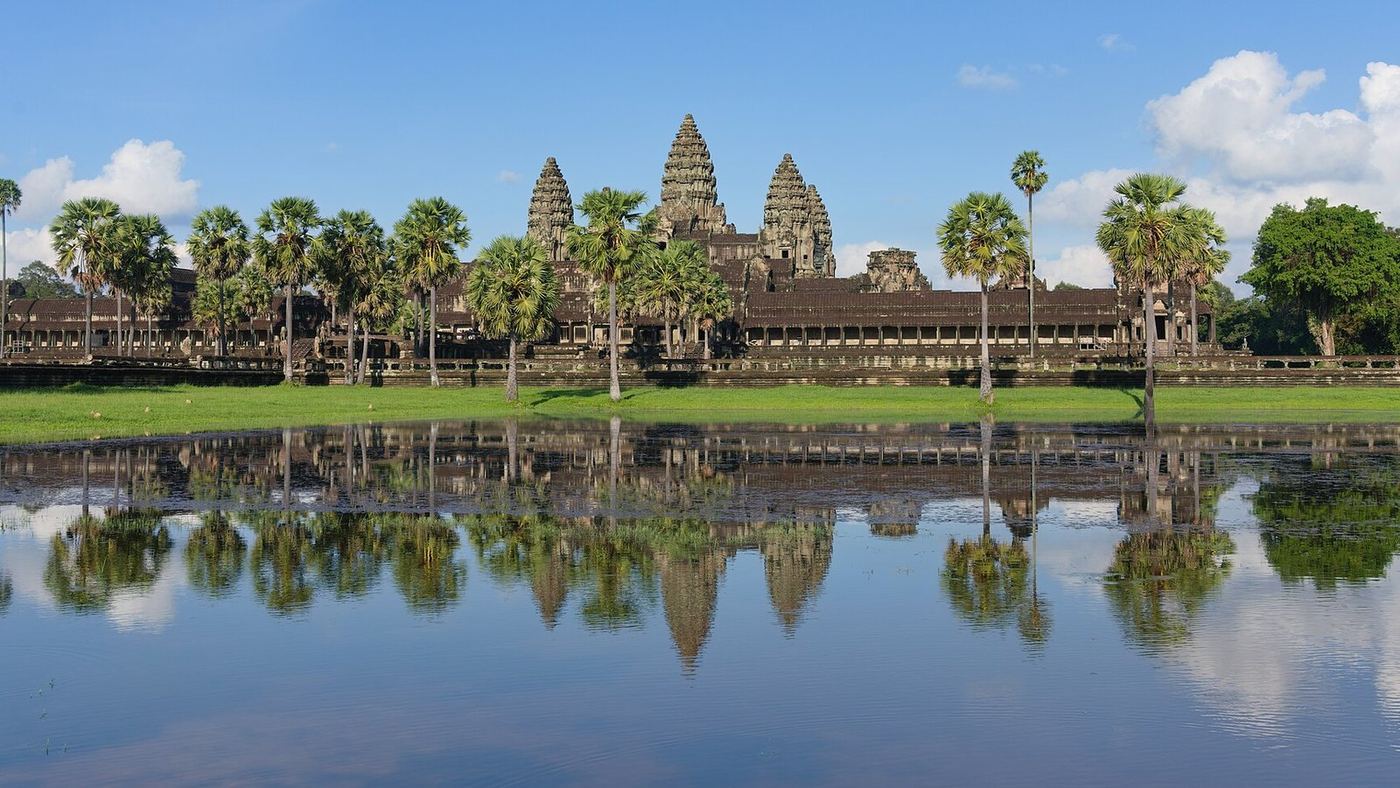
- The photograph is a place with the crowd cropped out. The pre-dawn gathering at the reflecting pool in front of Angkor Wat is several hundred people standing in the dark for a silhouette they have already seen. The picture is real; so is the crowd. Knowing which is which before you go is most of what makes a first trip land.
- Ten days shows one country, not a region. Ten nights is Tokyo and Kyoto, or the north and south of Vietnam, or Sri Lanka’s hills and one coast. It is not Japan, and it is not Southeast Asia. Deciding that early is what stops a first trip becoming a list.
What private does for a first-timer, and where a group departure wins
Every journey on this site is private, one party at a time, minimum two travellers, so treat what follows as an interested party being careful.
For somebody who has never been to Asia, the thing a private journey buys is not luxury. It is the ability to change the day: to leave at half past six because the temple is empty then, to stop when the jet lag lands at two in the afternoon, to spend three hours in one place instead of forty minutes in four, and to have somebody who speaks the language standing next to you the first time something is confusing. It also solves the eating problem quietly — allergies, vegetarian requirements and children who will not eat chilli are a matter for the guide rather than a nightly negotiation in a second language.
A group departure wins in three situations, and they are real ones. A solo traveller pays for the whole car and the whole guide on a private trip, which is a large premium for one person; somebody travelling alone who wants company at dinner is better served by a small group than by a driver and a guide; and a fixed departure at a published price with a fixed itinerary is easier to compare across operators, which matters if certainty is worth more to you than flexibility. The comparison in full, including the parts that do not flatter us, is on private or group.
A first plan in five steps, in this order
Almost every itinerary we have had to unpick was built in the wrong order — route first, month last. This is the order that works.
- Fix the month. Not the ideal month, the weeks you can actually take. Then read when to go against them: a fixed fortnight in July rules out most of India and the Gulf and hands you Sri Lanka’s east coast, Bali and the Central Asian mountains instead.
- Count the nights honestly. Nights on the ground, not days on the calendar, and subtract the arrival day. Two weeks of leave is usually eleven or twelve usable nights once the flights are counted.
- Decide one country or two. With eleven or twelve nights, one country at its comfortable length beats two at their minimums, and on a first trip it beats it by more than the arithmetic suggests, because the second country arrives just as you have stopped feeling foreign.
- Set a budget band before you look at journeys. Land arrangements on this site run from USD 190 per person per day at the bottom to USD 650 at the top, for the same standard of guide, car and hotel — the spread is the country, not the service. International flights sit outside that. How a price is built shows what is inside a day rate.
- Then send the enquiry. Month, number of nights, number of travellers, budget band, and anything already fixed at either end. That is enough for a first draft; the route is the last decision, not the first.
Three first journeys from our own catalogue
Each of these is a first trip we would defend to somebody who has never left Europe, North America or Australia, and each is a different answer to the same question.
Vietnam in 11 days, from USD 2,650
Hanoi to Ho Chi Minh City, north to south, no backtracking and no border. It is the cheapest per day of the three and the one that feels furthest from home, which for a first trip is the point. Eleven days is enough that the north and the south read as different countries, which is the thing about Vietnam that photographs never convey. Take it between February and April, or in November.
Japan in 12 days, from USD 6,400
Tokyo, Kyoto and Osaka, on trains, in a country where nothing administrative will go wrong. This is the journey for a traveller whose anxiety about Asia is really anxiety about competence — missed connections, illness, being lost. The planning problem in Japan is crowds rather than logistics, and crowds are an hours problem: a Kyoto day built around being at the well-known places before eight is a different city from the same day started at ten.
Sri Lanka in 11 days, from USD 3,100
Colombo to Galle by way of the hills, at a middle price, on an island small enough that eleven nights covers the ruined capitals, the tea country, a national park and a coast. It suits somebody who wants variety rather than depth on a first trip, and the entry formality is now free. Take the west and south from December to March; if your leave falls in July, the east coast is dry instead and the route reverses.
Send the month and the number of nights
You do not need a route, a country or a shortlist to write the first message. The month you can travel, how many nights you have and how many of you there are is enough for a first draft, which comes back within two working days — and if we think a first trip belongs somewhere other than where you asked, we will say so in that reply.
Questions travellers ask most
Is Asia safe for somebody who has never travelled outside the West?
For the countries on this page, ordinary caution is the whole answer: petty theft in crowded places, traffic, and the sun. Japan, Vietnam, Thailand and Sri Lanka are all countries where a careful traveller in their sixties has an uneventful fortnight, and Japan in particular is safer for a visitor than most European capitals.
What does need checking is the government advisory picture, which moves and is not the same as danger on the ground — the United States moved Jordan and Oman to Level 3 in 2026 over a regional conflict while Petra, Wadi Rum and all of Oman’s tourist geography sat outside the flagged areas. The dated position on every country we sell is on safety and advisories.
Should our first trip be one country or two?
One, if you have a fortnight or less. Eleven or twelve usable nights split across two countries means two arrival days, two departure days and an internal flight, and the country you meet second gets the tired half of the holiday.
Two works from about sixteen nights, and works best when the two are adjacent and genuinely different — Japan and South Korea, or Sri Lanka and south India. Three countries need close to three weeks, which is why our Grand Indochina is twenty-two days rather than sixteen.
How far ahead should a first trip be booked?
Six to nine months for the December to March peak, and four to six outside it. The binding constraint is rarely the hotels; it is the specific things with caps and timed slots, which now include Japanese ryokan in the autumn foliage weeks, the Kandy to Ella train in season, and permitted entry sessions in some national parks.
Later than that is workable but the shape of the trip starts being decided by availability rather than by you. If your dates are fixed and close, say so in the first message and we will tell you honestly what is still open.
What do we actually need to arrange ourselves?
Three things: the international flights, travel insurance, and the entry permission, which for most of these countries is an online application rather than an embassy visit — Vietnam’s e-visa is USD 25 for 90 days, Sri Lanka’s authorisation is free, Thailand’s arrival card is free, and Japan needs nothing in advance at all. Country by country, dated, that is on visas and entry.
Everything on the ground is ours: hotels, guides, driver, entrances, internal transport and the timed slots. Where a free government form exists we will tell you the official address for it, because the paid look-alike sites are the most common way a first-time traveller loses money before departure.
Read next
Tell us about the journey you have in mind
Dates, party size and the places you care about are enough to start. You get a draft route and an indicative price, not a brochure.