Eight nights, two valleys, and the climb saved for last
Paro, Thimphu, the Dochula pass, two nights on the rice terraces at Punakha, then back west with a spare day before the walk up to Taktsang. Bhutan is the most expensive country per night in this part of Asia, and the reason is a fee, not a hotel.
At a glance
- Duration
- 9 days, 8 nights
- Party
- Private, 2 to 8
- Starts
- Paro
- Ends
- Paro
- Difficulty
- Easy, with one long walking day
- From
- USD 4,900
Two valleys in eight nights, and no attempt to add a third. Bhutan tempts operators into Bumthang, which is another long day east on a road that does not hurry, and the result is a nine-day trip with four driving days in it. This route stays west, crosses the Dochula twice, and buys back the time as a spare day at Paro.
That spare day is not padding. Paro is one of the harder airports in commercial aviation to reach on schedule, and an itinerary that lands you on Monday and walks you up to Taktsang on Tuesday is an itinerary with no answer to a weather day. Ours puts the climb on the second-to-last day, with a whole free day in front of it that absorbs a late arrival without costing anybody the thing they came for.
The other reason to end rather than begin with the Tiger’s Nest is simpler. It is the steepest walk of the week and it sits above the valley floor; doing it on day two, straight off an aircraft, is how people spend the rest of the journey recovering.
Day by day
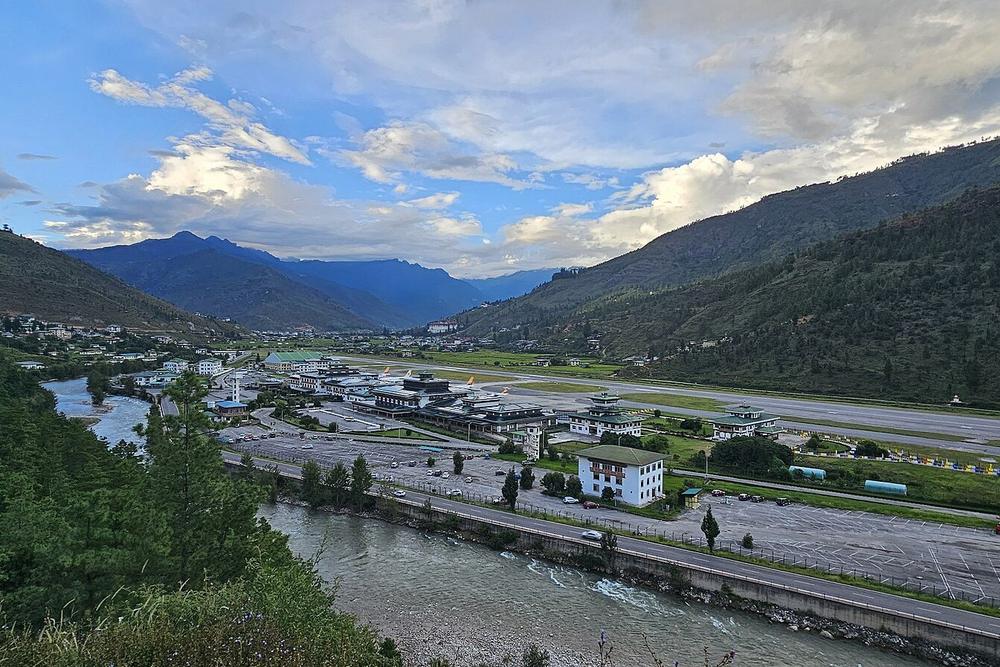
Two airlines fly into Paro and no others: Drukair, which is state-owned and operates five aircraft, and Bhutan Airlines, which operates two. Fewer than two dozen pilots worldwide hold the Paro certification — Drukair has around thirty-five pilots and only a handful of them are cleared for it.
The approach is visual, in daylight, in good visibility only. There is no ILS and no radar; a single VOR beacon and a set of landmarks. The aircraft descends by hand between peaks reaching 18,000 ft to an airport at 7,364 ft with a runway of 7,431 ft. Cloud diverts and delays flights regularly, and there is no fallback airport in the country.
The practical consequence is the buffer day on day 7. We also refuse to build a same-day onward international connection out of Paro, and we will say no to a client who asks for one.
Arrive Paro
The descent is the first thing anybody remembers about Bhutan and there is no point pretending otherwise: the aircraft turns between ridges with the valley floor below the wingtips and lands going one way because it can only land going one way. Your guide and driver meet you outside; both are Bhutanese, licensed, and with you for the whole journey.
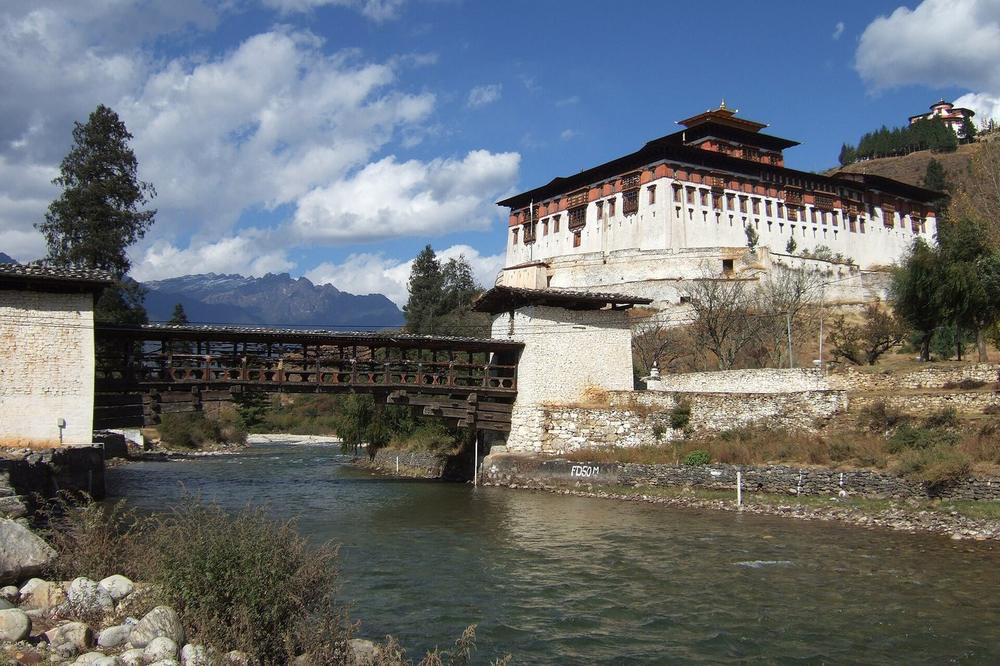
The afternoon is deliberately light. Rinpung Dzong, which is a fortress, a monastery and a district administration in one building, and the Kyichu Lhakhang, which is among the oldest temples in the country and still very much in use. Then an early night, because the valley is high and most people feel it.
Paro to Thimphu
A short drive east, about an hour, following the river down and then up the other valley. Thimphu has no traffic lights. The junction in the middle of the city is still worked by a policeman in a box, and the arrangement has outlived more than one attempt to replace it with a signal.
The afternoon is the Buddha Dordenma above the city, then the National Textile Museum, which is the single best hour in Thimphu for understanding what is on everybody around you. Bhutanese dress is not costume; the kira and the gho are daily wear, required in dzongs, government offices and schools, and the weaving that goes into a good one takes months.
Thimphu
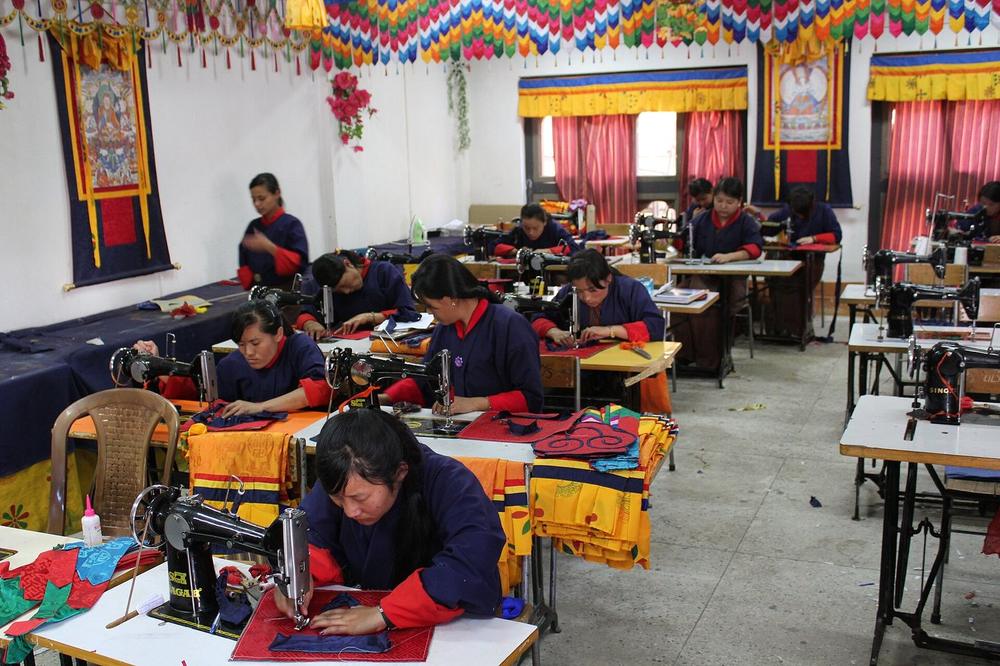
A morning at the Institute for Zorig Chusum, the school of the thirteen traditional arts, where students spend years on painting, embroidery, woodcarving and casting. Watch rather than shop; the shop at the front is fine and the classrooms are the reason to be there.
The afternoon is a walk rather than a building: up the valley to Cheri or Tango, a monastery on a wooded hillside reached on foot in about an hour of steady climbing. This is also the sensible altitude rehearsal for day 8. If the weekend falls here, the Thimphu market takes the morning instead and the walk moves.
Thimphu to Punakha over the Dochula
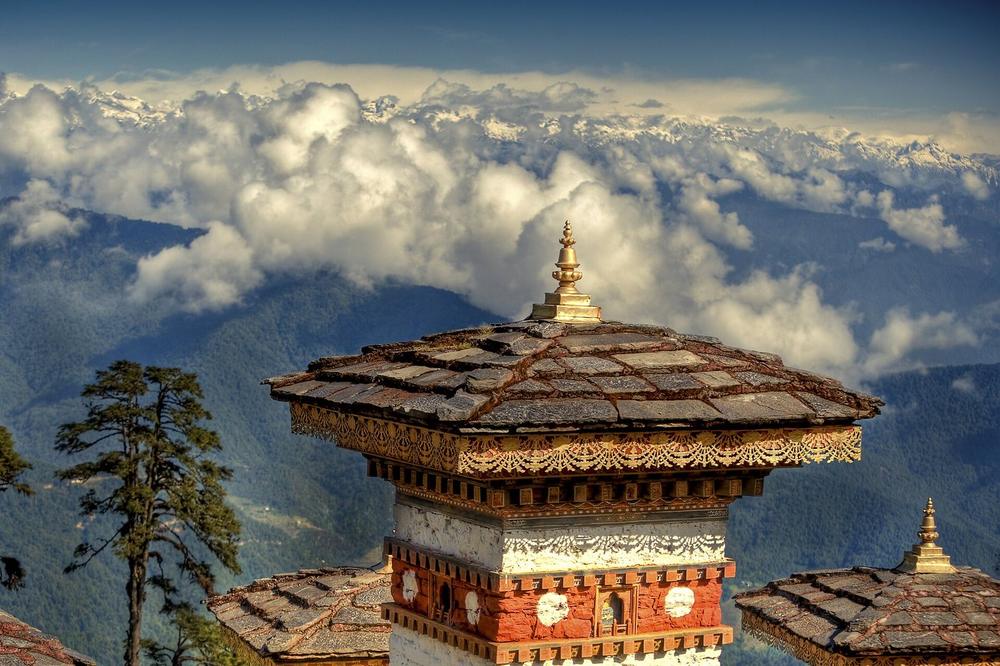
East out of Thimphu and up to the Dochula, a pass with a field of chortens on it and, on a clear winter morning, the eastern Himalaya laid out along the northern horizon. On a cloudy one you see the chortens and the prayer flags and nothing else. We stop for as long as the weather deserves.
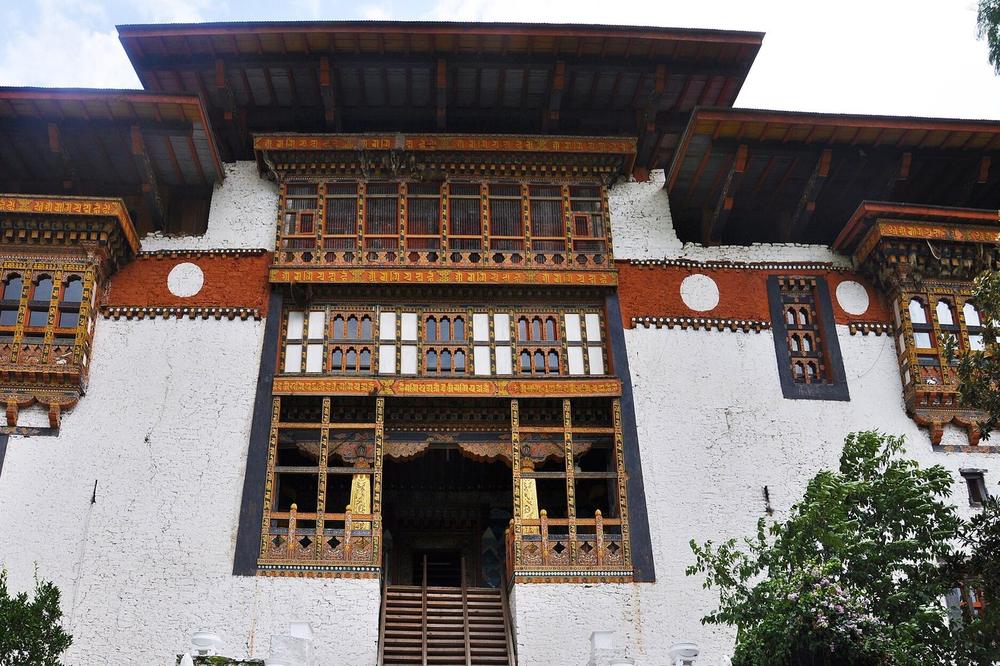
Then down, a long way down, into a valley warm enough for rice and bananas. Punakha Dzong stands at the confluence of the Pho Chhu and the Mo Chhu, reached across a covered wooden bridge, and it is the building most people rate above every other in the country. Go late in the afternoon when the light is on the whitewash.
Punakha
The walk to the Khamsum Yulley Namgyal chorten takes the morning: across a suspension bridge, along the river, then up through the terraces for about an hour to a temple built by the queen mother with a view back down the whole valley. It is the prettiest ordinary walk in Bhutan and it is not hard.
The afternoon is Chimi Lhakhang, reached on a path through the fields, and the village around it, which is decorated in a way that surprises visitors who have read about Bhutan only as a Buddhist kingdom. Your guide will explain the Drukpa Kunley story and will not be embarrassed about it.
Punakha back to Paro
Back over the Dochula and west, four to five hours with stops, which is the longest driving day of the journey and still an easy one by the standards of the Himalaya. The road is good, it is narrow, and it is being widened in places, which occasionally costs half an hour.
Arrive Paro in the afternoon. Nothing else is scheduled, on purpose: tomorrow is the day that exists to be given away.
Paro, the day held in reserve
This day exists to absorb a delayed arrival. If your inbound flight lost a day to cloud, the schedule has already used this one up and you still climb to Taktsang tomorrow. If it did not, you get a free day in the Paro valley and here is what we would do with it.
Drive up the valley to the ruined Drukgyel dzong, burnt in the 1950s and reconstructed since, which stands where the road to Tibet used to matter. Then a farmhouse lunch in a working house rather than a set-up one, and a hot stone bath in the afternoon if you want one, which is a wooden tub, river stones heated in a fire and dropped in through a partition, and artemisia in the water. It is a genuine local practice and it is also the correct preparation for tomorrow.
The Tiger's Nest
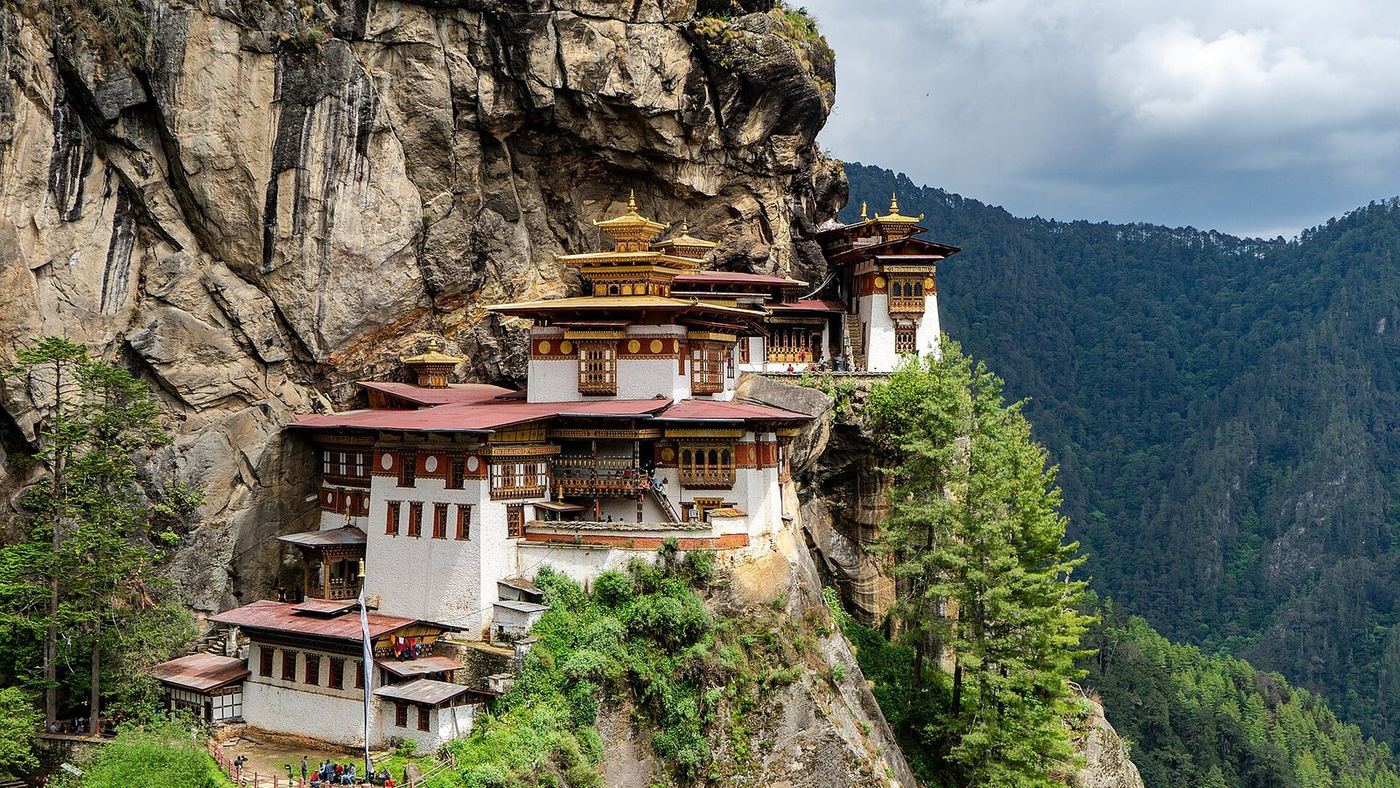
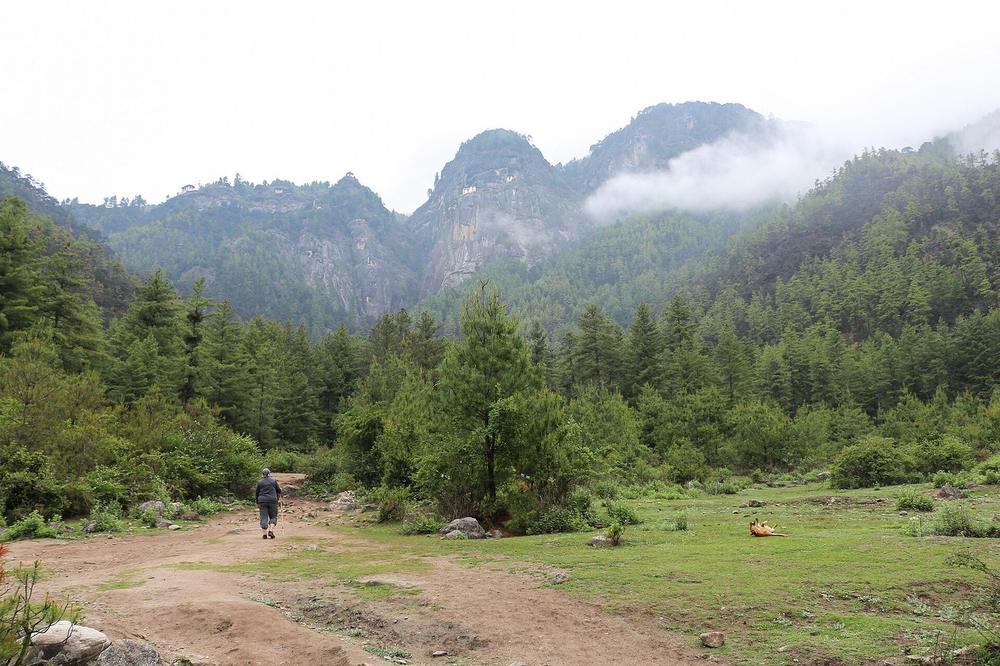
Leave at seven to be walking by half past. Taktsang is built onto a cliff face above the valley and the path climbs steadily through pine to a cafeteria at roughly the halfway point, then continues to a viewpoint, then drops down a long flight of stone steps and climbs back up the other side to the monastery door. Most people take two to three hours up and a little less down.
It is not technical and it is not a scramble. It is simply a long climb at altitude, and the reason we put it on day 8 rather than day 2 is that by now you have had a week of valley air and an hour of climbing at Cheri behind you. Ponies are available for part of the ascent and not for the descent, which is the half that hurts; we tell people that before they book the pony.
Bags, cameras and phones are left at the entrance to the monastery itself. The interior is the part nobody photographs and the part everybody describes.
Depart Paro
Breakfast and the short drive to the airport. Departures out of Paro go early, in the daylight window, which is why the last night is spent in the valley rather than anywhere else. We do not book an onward international connection on the same day and we will explain why if you ask us to.
What it costs, and where the government fee sits
Bhutan charges a Sustainable Development Fee of USD 100 per adult per night. On this journey that is 8 nights × USD 100 = USD 800 per adult, and that USD 800 is already inside every cell of the table. You will not be asked for it at the airport, at the hotel or in a final invoice.
The USD 100 rate is half the USD 200 headline figure and the halved rate is confirmed in force through 31 August 2027. What happens on 1 September 2027 has not been announced. If you are planning a departure after that date, we will quote the SDF separately and re-confirm it before you pay a balance, rather than absorb a doubling we cannot predict.
Children pay less: nothing under 6, USD 50 per night from 6 to 11, the full USD 100 from 12. Ask and we will price a family properly rather than per adult.
| Party size | Comfortable | Considered |
|---|---|---|
| 2 travellers | USD 6,650 | USD 9,050 |
| 3 – 4 | USD 5,550 | USD 7,550 |
| 5 – 8 | USD 4,900 | USD 6,650 |
Bhutan is the most expensive country on this site per night and the reason is structural rather than commercial. Take the USD 800 fee out of the lowest cell and the remaining USD 4,100 buys eight nights, a private car, a licensed Bhutanese guide and every meal — which is not an outlandish number for the Himalaya. The fee is what makes Bhutan Bhutan, and it is also what makes a cheap Bhutan quote a warning sign rather than a bargain.
If a competing quote is materially below these figures, ask one question: is the SDF in it. Most of the time the answer is no, and USD 800 per person reappears later.
Comfortable is good four-star and the better valley lodges, which in Bhutan are genuinely comfortable and often family-run. Considered is the small number of internationally-run lodges in the Paro, Thimphu and Punakha valleys, which are among the most expensive rooms in Asia and are priced accordingly. The guide, the driver, the car and the fee are identical in both columns.
How the daily rate is built across the region, before any margin, is set out on the prices page.
What is and is not included
What the price includes
- The Sustainable Development Fee, USD 100 per adult per night, 8 nights, USD 800 per adult, paid on your behalf
- The Bhutanese visa, applied for and issued through our licensed Bhutanese partner before you travel
- Eight nights as listed, named by property in your quote
- A licensed Bhutanese guide and a private driver for the full nine days
- All meals, breakfast to dinner, from lunch on day 1 to breakfast on day 9
- All entrance fees, including the dzongs, Zorig Chusum and Taktsang
- Drinking water in the vehicle and on the Taktsang climb
What it does not include
- International flights into and out of Paro, which we will book for you on Drukair or Bhutan Airlines but do not include in the land price
- Travel insurance, which we require and do not sell
- Alcohol and soft drinks with meals
- The hot stone bath on day 7, and any spa treatment
- A pony on the Taktsang ascent, if you decide on the morning that you want one
- Tips for the guide and driver, which are customary and never built into our prices
The journey in pictures
Who this journey is wrong for
- Anyone shopping on headline price. USD 800 of the lowest figure on this page is a government fee that every legitimate operator pays identically. A quote that undercuts ours by a third has either excluded the fee or excluded the guide, and in Bhutan you cannot legally travel without either.
- Anyone with a tight onward connection out of Paro. Two airlines serve the airport, landings are daylight and visual only, and cloud delays and diverts flights with no alternate in the country. We will not build a same-day international connection and we will decline the booking rather than build one for you.
- Anyone who wants a trek. This is a valley journey with two hard-ish walks in it. The Druk Path is five to six days and reaches about 4,210 metres; Jomolhari is eight to twelve. Both are a different trip with a different fitness requirement, and all trekking in Bhutan must run through a licensed operator with the SDF still charged for every night on the mountain.
- Anyone who cannot manage the walk up to Taktsang. There is no road, no cable car and no alternative viewpoint worth the drive, ponies do not come down, and it is the last full day. If the climb is genuinely out of reach, say so and we will redraw the journey around Punakha and Haa instead of selling you eight nights ending in a car park.
- Anyone booking a festival week and expecting quiet. Paro Tshechu falls on 18 to 22 March 2027 and Thimphu Tshechu on 10 to 12 October 2027; hotels in those valleys fill months ahead and the dzong courtyards are packed. The festival is worth seeing. It is not a peaceful week and we will not describe it as one.
How this compares, and when to come
| Journey | Days | Countries | From |
|---|---|---|---|
| Bhutan | 9 | Bhutan | USD 4,900 |
| India, Nepal and Bhutan | 21 | India, Nepal, Bhutan | USD 8,200 |
| Nepal | 10 | Nepal | USD 2,600 |
| Rajasthan and the Golden Triangle | 12 | India | USD 3,200 |
Bhutan is short by design. Seven to ten nights is what the western valleys hold before the road east starts costing more than it returns, and the SDF makes every extra night a real decision rather than a rounding error. Most people who want longer are better served by adding Nepal, where the daily cost is a fraction of this and the walking is the point.
For the country outside a fixed route — the months, the festivals, the way the fee works and what it pays for — read the Bhutan destination page. If the paperwork is the part that worries you, the visas and entry page covers every country on this site.
Tell us your dates
Send the month and the number of travellers, and tell us whether anyone in the party has a knee that will object to Taktsang. A first draft comes back within two working days.
Questions travellers ask most
Is the Sustainable Development Fee included, or paid separately?
Included. The fee is USD 100 per adult per night and this journey has 8 nights, so USD 800 per adult sits inside every figure in our price table. Nobody will ask you for it again.
We do it this way because the alternative — quoting a low land price and adding USD 800 at the deposit stage — is how a comparison between two operators becomes meaningless. Children under 6 pay nothing and those aged 6 to 11 pay USD 50 per night, so a family quote is genuinely lower and we will build it that way.
Why does the halved rate have an end date?
The full fee is USD 200 per adult per night. Bhutan halved it to USD 100 to bring visitor numbers back after the pandemic, and the halved rate is confirmed in force through 31 August 2027.
Nothing has been announced about what follows. For departures after that date we quote the SDF as a separate line and re-confirm it before the balance falls due, because a return to USD 200 would add USD 800 to an eight-night journey and that is not a surprise anyone should absorb.
Why is there a spare day in the middle of a nine-day trip?
Because of how Paro works. Two airlines fly there, fewer than two dozen pilots worldwide are certified for the approach, and every landing is visual, in daylight, in good visibility, with no ILS or radar and no alternate airport in the country. Cloud delays and diverts flights regularly.
Day 7 is the shock absorber. If you lose a day arriving, the schedule swallows it and you still walk to Taktsang. If you do not, you get a free day in the Paro valley, which is where the farmhouse lunch and the hot stone bath live. Building a nine-day Bhutan itinerary without that day is the most common mistake we see in other people’s quotes.
Can we travel independently, or add a trek?
Not independently. Every visitor outside the regional-national categories travels on a package arranged through a licensed Bhutanese operator with a licensed guide, and the SDF is charged per night regardless of what you do with the day.
A trek can be added and must run through the same licensed structure. Druk Path is five to six days and tops out at about 4,210 metres, which is the accessible one; Jomolhari is eight to twelve days and reaches about 4,890 metres. Note that the SDF applies to every night on the mountain as well, so a six-day trek adds USD 600 in fee alone before a tent.
Read next
Tell us about the journey you have in mind
Dates, party size and the places you care about are enough to start. You get a draft route and an indicative price, not a brochure.