The country where one number decides everything else
Almost every question about visiting Bhutan resolves into the same figure. The Sustainable Development Fee is USD 100 per adult per night, it is confirmed at that rate to 31 August 2027, and it governs how long you stay, how you get in and what the trip is worth.
At a glance
| Region | The Himalaya |
| Nights that work | 7 to 10 in the western valleys |
| Best months | March to May, and September to November |
| Worst months | June to August, the monsoon on the southern slopes |
| Only airport | PBH Paro |
| Entry | Visa through a licensed operator, plus the SDF |
| The fee | USD 100 per adult per night, confirmed to 31 August 2027 |
| Ground cost | USD 480 to 650 per person per day, land only, fee included |
What this country actually is
Bhutan is a small Himalayan kingdom that decided, deliberately and a long time ago, not to compete on volume. Independent travel does not exist here for anybody outside the regional passport categories. You come on a package put together by a licensed Bhutanese company, you are accompanied by a licensed Bhutanese guide, and the government charges you by the night for being in the country at all. Whether that reads as principle or as expense depends mostly on what you were expecting, and it is a question better settled before an enquiry than after a quote.
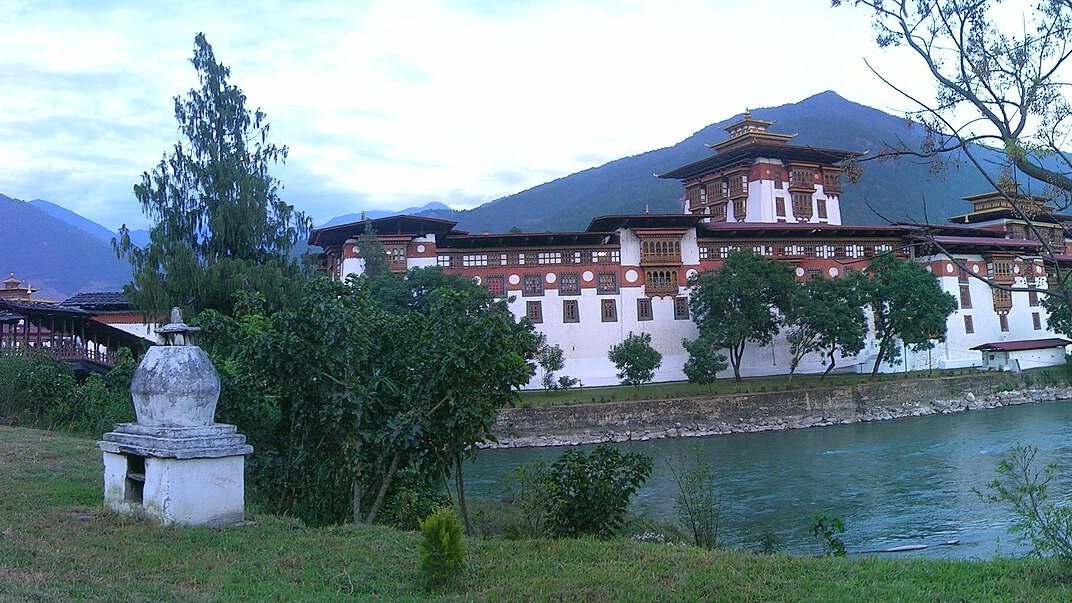
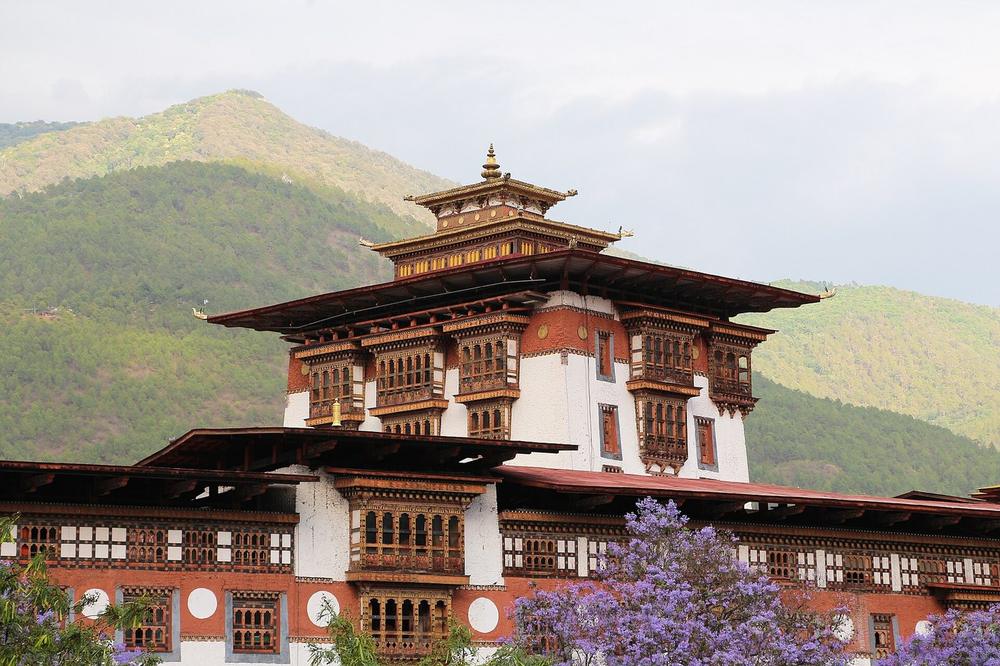
What the money buys, physically, is a country that still looks like itself. The gho and the kira are ordinary clothes here rather than costume, worn to work and to school and required inside any dzong or government building, and a good one takes a weaver months. Nor are the dzongs museums: each one is fortress, monastery and district office at once, with monks and civil servants crossing the same courtyard. The capital, Thimphu, still has no traffic lights, and the busiest junction in it is directed by hand from a painted box.
Geographically, the part visitors see is narrow. The western valleys — Paro, Thimphu, Punakha, Haa, Phobjikha — sit between roughly 1,200 and 3,000 metres and are connected by good, narrow roads over passes. East of Phobjikha the country opens out into Bumthang and beyond, on roads that add a full day each way and that a week does not have room for.
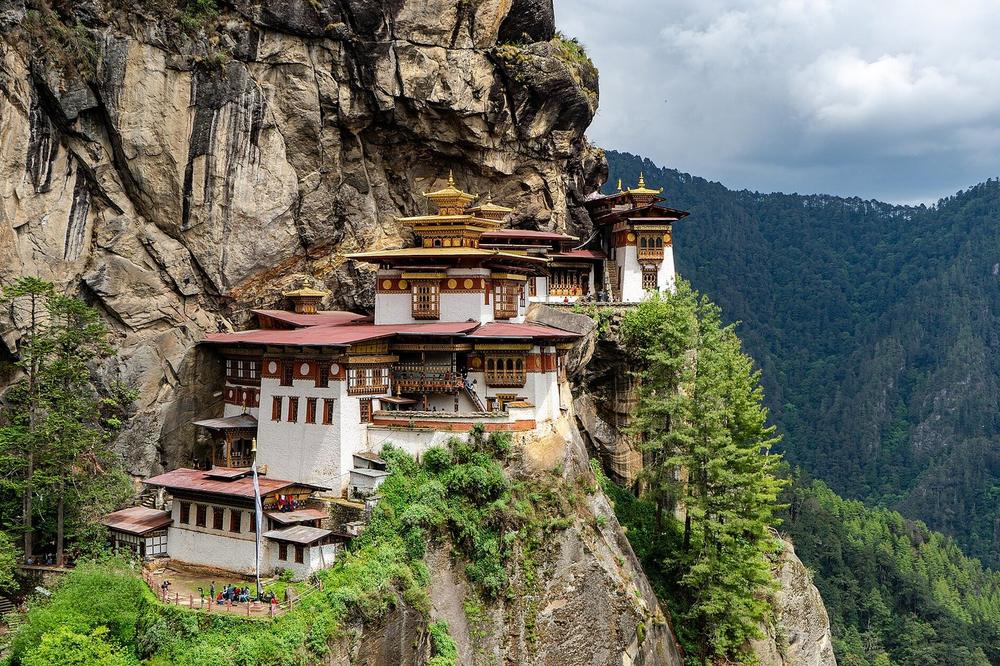
And it is a walking country at modest altitude rather than a trekking country by default. Taktsang, the monastery built onto a cliff above the Paro valley, is a steady two to three hours up on a path through pine with a long flight of stone steps in the middle of it. That is the hardest thing on most Bhutan itineraries, and it is enough for most people.
How many nights, and what breaks if you take fewer
Seven to ten nights covers the western valleys properly. Fewer than seven and the fee stops being value; more than ten and you are either heading east on a long road or trekking.
The Sustainable Development Fee is USD 100 per adult per night for international visitors aged 12 and over. It is confirmed in force at that rate through 31 August 2027. It is half the USD 200 headline figure; the halved rate began in September 2023, which makes it roughly a four-year discount window, and nothing has been announced about what happens the day after it ends.
The scale for children is lower: under 6 nothing at all, then USD 50 a night up to the age of 11, then the full rate. Regional passports are charged on a different scale again — INR 1,200 a night for Indian nationals, USD 15 for Bangladeshi ones — which is why a number quoted on a travel forum may have no bearing on what you will be asked for.
The fee applies to every night of the stay, including nights on a trek. It is not an entry charge and it is not refunded for a day spent in a vehicle. Two travellers on an eight-night journey are looking at USD 1,600 in fee alone before a room, a car or a guide.
That is why the length question is genuinely a money question here in a way it is not in Nepal or India. Each additional night has a hard USD 100 floor under it before anything else is bought, so padding an itinerary is expensive and obvious. The corollary is that the nights you do take should be worth taking: two valleys done slowly beat three valleys done from a car window, and the drive east to Bumthang is exactly the addition that a nine-day trip cannot absorb.
One night that is not optional, on any competent itinerary, is a spare one. More on that below, because the reason lives at the airport.
When to go, and what the wrong months give you back
| Months | What it is like | The trade |
|---|---|---|
| March to May | Clear spells, warm valley days, rhododendron on the passes, and the spring festival season | The busiest half of the year. Festival weeks fill valley beds months ahead |
| June to August | The monsoon reaches the southern slopes: cloud, rain and hidden mountains | The valleys are at their greenest and emptiest, and Punakha at rice-planting is a working landscape rather than a view |
| September to November | The clearest air of the year and the sharpest mountain views, with the autumn festivals | Peak demand again, and the SDF does not discount for anybody |
| December to February | Cold, bright, and very quiet; passes can hold snow | Black-necked cranes are wintering at Phobjikha, and you will have the dzongs largely to yourself |
The festivals are the reason many people pick a month, and the dates move with the lunar calendar, so they need confirming rather than assuming. Paro Tshechu runs 29 March to 2 April in 2026 and 18 to 22 March in 2027; Thimphu Tshechu runs 21 to 23 September in 2026 and 10 to 12 October in 2027. The festival is worth seeing and it is not a quiet week: the dzong courtyards are packed, and hotel rooms in the relevant valley are gone months out. Anyone selling you a festival departure as a peaceful cultural encounter has not been to one.
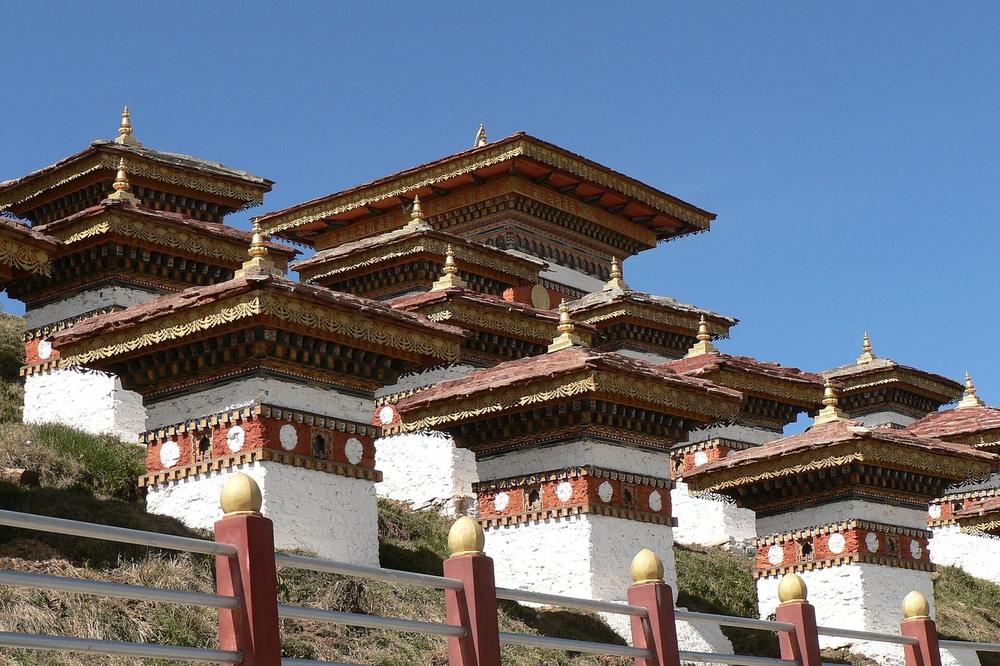
Winter is the underrated window. It is cold, it is bright, the mountain views from the Dochula are at their most reliable, and the cranes are at Phobjikha from late autumn. You are paying the same USD 100 a night to share the country with far fewer people. The month-by-month picture for the whole region is on when to go.
Getting there, and why the flight shapes the itinerary
There is one international airport, at Paro (PBH), and getting into it is the single most itinerary-relevant fact about the country.
The airline list is two names long. Drukair, which the state owns, flies five aircraft; Bhutan Airlines flies two. The certification to land at Paro is held by under two dozen pilots anywhere in the world, and although Drukair employs around thirty-five, only a small number of them carry it. Nothing lands there at night, in cloud or on instruments: there is no ILS and no radar, just one VOR beacon and a set of landmarks read out of the window. The descent is flown by hand between ridges that rise to 18,000 ft, onto a field sitting at 7,364 ft with 7,431 ft of runway, and if the weather closes there is nowhere else in the country to put the aeroplane.
None of that should read as drama. What it should produce is a spare day in the schedule. Weather turns Paro flights back often enough that an arrival on Monday followed by the climb to Taktsang on Tuesday leaves you no answer when Monday does not happen — and an itinerary built that way has handed you the risk without mentioning it. A day held loose absorbs the whole problem. The matching discipline is never to schedule an onward international flight for the day you leave Bhutan, which any competent operator will decline to do even when asked.
Most travellers reach Paro from Delhi, Kathmandu, Bangkok or Singapore, which is why Bhutan is so often attached to India or Nepal rather than flown to on its own. Once inside the country, everything is by road with a private driver, and there is no other option to consider: the valleys are two to four hours apart over passes, and the roads are good, narrow and occasionally under widening works.
What it costs on the ground
Bhutan sits in the highest of our price bands, roughly USD 480 to 650 for each traveller each day, land only, and the reason is a policy rather than a margin. Subtract the USD 100 nightly charge from any quote and what is left is an ordinary Himalayan daily rate: a room, a car with a driver, a licensed guide and, because of the way packages are structured here, every meal.
This has one useful consequence when you are comparing operators. Every legitimate company pays the same fee, so a Bhutan quote that undercuts another by a third has almost certainly either left the SDF out or left the guide out, and you cannot legally travel without either. The question to ask a cheaper quote is not "why is it cheaper" but "is the Sustainable Development Fee inside this number". Most of the time it is not, and USD 100 a night reappears later.
The spread between hotel grades is narrower than the price band implies. Solid four-star and the better valley properties are frequently family-run and perfectly comfortable. Above them sit a handful of internationally operated lodges spread across the three western valleys, whose rates are among the highest in Asia. What does not vary between the two is everything else: same fee, same car, same driver, same guide.
For a departure after 31 August 2027, the sensible practice is to see the SDF quoted as a separate line and reconfirmed before the balance falls due. A return to USD 200 a night would add USD 800 to an eight-night trip, and that is not a surprise anyone should be asked to absorb quietly. What a day costs across the rest of Asia is on cost by country.
In pictures
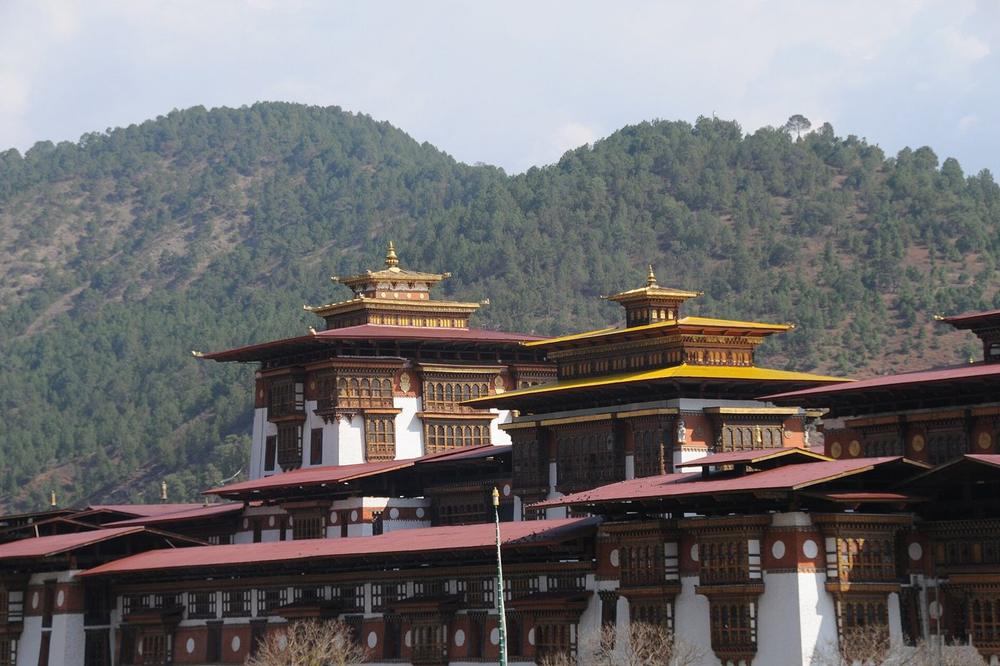
When to skip it
- If the nightly fee reads to you as a tax rather than a policy. USD 100 per adult per night is not negotiable, not waivable and not avoidable, and resenting it for eight nights makes a good trip miserable. Nepal delivers Himalayan travel at roughly a third of the daily cost and more walking.
- If you have a fixed onward connection you cannot move. Two airlines, a visual daylight approach, no alternate airport, and cloud that delays and diverts flights regularly. Bhutan needs slack on both ends of the trip and will punish an itinerary that has none.
- If you want a serious trek inside a short holiday. Every trek runs through a licensed operator and the nightly fee follows you onto the mountain. Druk Path takes five or six days and reaches about 4,210 m; Jomolhari takes eight to twelve and reaches about 4,890 m; the Snowman takes twenty-four to thirty and crosses eleven passes above 4,500 m. These are expeditions with a government charge attached to each night under canvas.
- If Taktsang is beyond the party physically. Nothing drives up, nothing lifts you up, and the ponies that go up do not come down; there is no viewpoint elsewhere worth the substitution. A journey around Punakha, Haa and Phobjikha instead is a perfectly good trip — but it wants deciding at the enquiry, not discovered at the trailhead.
- If June to August is your only window and mountains are the point. The monsoon sits on the southern slopes and the high views go with it.
Journeys that go here
Bhutan in nine days runs Paro to Thimphu to Punakha and back over the Dochula, with a spare day held in the Paro valley before the climb to Taktsang on the second-to-last day. The Sustainable Development Fee for all eight nights is inside the quoted price rather than added later, which is the only way a Bhutan quote can honestly be compared with another one.
If you have three weeks and want the Himalaya as a whole, India, Nepal and Bhutan in twenty-one days takes Delhi to Paro to Kathmandu, which is also the cheapest way per day to include Bhutan at all, because the Indian and Nepali nights pull the average down. Travellers deciding between the two Himalayan kingdoms should read the Nepal page beside this one; they are not substitutes for each other.
Send the month and the party
Give us your dates, the size of the party and an honest word about how everyone walks. The first number we come back with will be what the government fee adds up to across your nights.
Questions travellers ask most
What exactly is the Sustainable Development Fee?
A government charge of USD 100 for every adult for every night spent in the country, trekking nights included, confirmed at that level through 31 August 2027. The rate written into the legislation is USD 200; the half rate has been in place since September 2023.
Under-6s are exempt and 6-to-11-year-olds are charged USD 50 a night, so a family quote genuinely comes out lower and ought to be built that way rather than priced per adult. Because every licensed company pays the same amount, this is the single most revealing line to compare when two Bhutan quotes are far apart.
Why does everyone insist on a spare day?
Because of the airport. Two airlines serve Paro, under two dozen pilots anywhere hold the rating for the approach, and it can only be flown in daylight and in clear weather without instruments or radar, with no second field in the country to divert to. Cloud turns flights back regularly enough that it should be planned for.
With a day in reserve, a lost arrival costs you an afternoon of scenery instead of the walk you came for. It is also the reason a serious operator will not put an onward international flight on your departure date, and will say so rather than take the booking and hope for a clear morning.
Can we travel independently, or hire our own car?
No. Outside the regional passport categories, everybody arrives on a package assembled by a licensed Bhutanese company, with a licensed guide and a driver attached, and the nightly fee is charged whatever you do with the day. Trekking works the same way: unguided walking is simply not allowed.
None of this is the travel industry adding margin. It is the tourism model the country chose for itself, and it is a large part of why the valleys still look the way they do.
Is a festival week worth planning around?
Yes, if you want the spectacle and no, if you want quiet. Paro Tshechu falls 29 March to 2 April in 2026 and 18 to 22 March in 2027; Thimphu Tshechu falls 21 to 23 September in 2026 and 10 to 12 October in 2027. Dates follow the lunar calendar and shift each year, so they should be reconfirmed rather than assumed.
Beds in the relevant valley go months ahead and the dzong courtyards are full. If the calm version of Bhutan is what you are after, come in late autumn or in winter, when the same USD 100 a night buys you a much emptier country.
Read next
Tell us about the journey you have in mind
Dates, party size and the places you care about are enough to start. You get a draft route and an indicative price, not a brochure.